Posts Tagged “jury”

“Better that ten guilty persons escape than that one innocent suffer”

William Blackstone Commentaries on the Laws of England (vol 4) 358
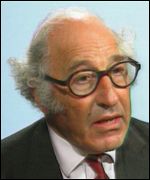
Sir Louis Blom-Cooper QC, via the BBC website With very little coverage (Day 1: Irish Times here and here | RTÉ; Day 2: Irish Times), a case which had the capacity to make a fundamental change to Irish defamation law was decided in the Supreme Court at the end of last week. Two members of the Birmingham Six have taken defamation proceedings against leading English human rights barrister Sir Louis Blom-Cooper QC (pictured left). Blom-Cooper sought to have the case struck out on the basis that his expression of opinion was constitutionally protected. However, the Supreme Court allowed the case to proceed, and (if the press reports are accurate) ducked the constitutional question, at least for the time being.

The story begins with the presumption of innocence, embodied in the quote from Blackstone, above. In Woolmington v DPP [1935] AC 462, [1935] UKHL 1 (23 May 1935) Viscount Sankey held that “the presumption of innocence in a criminal case is strong”, and emphasised, that throughout the web of the criminal law,

… one golden thread is always to be seen that it is the duty of the prosecution to prove the prisoner’s guilt … If, at the end of and on the whole of the case, there is a reasonable doubt, created by the evidence given by either the prosecution or the prisoner, as to whether the prisoner killed the deceased with a malicious intention, the prosecution has not made out the case and the prisoner is entitled to an acquittal. No matter what the charge or where the trial, the principle that the prosecution must prove the guilt of the prisoner is part of the common law … and no attempt to whittle it down can be entertained.

Furthermore, it is now clear that the presumption of innocence does not merely apply during the course of a trial. In R v Hickey [1997] EWCA Crim 2028 (30 July 1997) the Court of Appeal in England held that, where an appeal court quashes convictions, the presumption of innocence in respect the appellant is re-established. In J O’C v DPP [2000] IESC 58 (19 May 2000), Hardiman J referred to Hickey and other cases to conclude that

… the presumption of innocence applies to all unconvicted persons. This is so whether they are unconvicted because the trial has not yet taken place or because a conviction has been quashed.

The whole issue is brilliantly treated in Claire Hamilton’s superb book The Presumption of Innocence in Irish Criminal Law. ‘Whittling the Golden Thread’ (Irish Academic Press, Dublin, 2007). However, at least in the context of convictions set aside on appeal, this was not an incontestable view of the law. In 1997, Blom-Cooper, argued that the Court of Appeal got it wrong in the Hickey case, and that the presumption of innocence persists until a conviction, but once it is gone, it is not revived by the quashing of the conviction on appeal.

Birmingham Six, via RTE news website.Commentators disagree with judges all the time. Indeed, I have done so regularly on this blog. And Blom-Cooper is an outspoken commentator who regularly argues for alternative views of the law. However, in this case, he may have gone too far. He made this argument in a pamphlet called The Birmingham Six and Other Cases. Victims of Circumstances (Duckworth, 1997). In it, he examined recent miscarriages of justice, such as the case of the Birmingham Six (pictured left), to raise once again his longstanding objections to the current system of trial by jury and to explore the consequences of the professional failure to explain the function of the Court of Appeal. Two of the Birmingham Six, Gerry Hunter and Hugh Callaghan, sued Blom-Cooper and his publisher, Duckworth, for defamation, alleging that various comments made by Blom-Cooper in the pamphlet constituted both an overt and a covert attack upon their innocence.

Once the Irish High Court had held that the case could be brought in Dublin, Blom-Cooper sought to have the case struck out on the basis that he had done no more than to express an opinion, which was a right absolutely protected by the Irish Constitution. It was an extraordinary claim – the right to freedom of expression protected by Article 40.6.1(i) of the Irish Constitution is still under-developed, and was considerably more anaemic ten years ago – but the argument held out the prospect of improving this state of affairs. Read the rest of this entry »

Comments 3 Comments »

12 Angry Men, dvd cover, via rotten tomatoes website.In a previous post, I looked at the restrictions on publishing jury deliberations. Now comes the news that, in the UK, the Attorney-General has been given the go-ahead to prosecute The Times:

The Attorney-General has been given permission to bring contempt of court proceedings against the publishers of The Times and the foreman of a jury alleged to have revealed “secrets of the jury room”.

The foreman’s anonymous criticism of the conviction of a childminder for the manslaughter of a baby in her care was reported in a Times article in 2007. At the High Court, Baroness Scotland of Asthal, QC, was given leave to bring proceedings against Times Newspapers Ltd and the foreman. The newspaper had not been informed of the hearing.

Lord Justice Maurice Kay said: “We don’t think this is the very gravest case of jury indiscretion – nevertheless we grant permission.”

One question which I assume will arise – as Joseph Jaconelli suggested in (1990) 10 Legal Studies 91 and in chapter 7 of Open Justice: A critique of the Public Trial (OUP, 2002) – will be as to the extent to which freedom of expression, on the part both of the juror and of the media, trenches upon the traditional absolute secrecy of the jury room. We shall have to watch this space.

Comments No Comments »

Creative Commons Attribution-NonCommercial-ShareAlike 3.0 Unported
This work by Eoin O Dell is licensed under a Creative Commons Attribution-NonCommercial-ShareAlike 3.0 Unported.