Posts Tagged “older people”

Jeremy Bentham auto-icon, via UCLJeremy Bentham (1748-1832) (left) was a utilitarian philosopher, whose radical ideas on education inspired those who founded University College London. Nowadays, the Bentham Association (formerly the Bentham Club) is the Alumni Association for UCL’s lawyers, and it annually hosts a Presidential Address from an invited senior lawyer. This year’s address was given by Lord Pannick QC on the topic:

“Better that a horse should have a voice in that House [of Lords], than that a judge should” (Jeremy Bentham).

Replacing the Law Lords by a Supreme Court

It broadly concerned the implications of the removal of the final court of appeal from parliament, and can be heard online here. It covers a wide range of very interesting material, and is very well worth listening to. There’s no text yet online, but one aspect of it appears in Pannick’s column in today’s Times, taking the field on an issue I’ve looked at already on this blog (here and here); some extracts:

Seventy is far too early for a supreme court judge to retire . . .

… The argument for a retirement age of 75 for all supreme court justices is very simple. Those appointed are the cream of the judiciary. They inevitably take time to rise to the top, normally after serving for several years in the High Court and then in the Court of Appeal. It seems an awful shame to throw out judicial resources of such quality after a short stay in the supreme court when they are still fresh in mind and body and well short of their sell-by date.

… One can sympathise with the comments of Lord Bridge of Harwich in his final case in the Appellate Committee in 1995 when he expressed his annoyance at “the statutory presumption of judicial incompetence at the age of 75”. Lord Bridge, still at the peak of his considerable intellectual powers, went off to study for a mathematics degree.

… The appropriate balance between innovation and experience (or, if you prefer, between immaturity and senility) is, I think, a retirement age of 70 for judges of the High Court and the Court of Appeal. But for the supreme court, given the length of time that it will take for judges to arrive at such legal heights, a retirement age of 75 is more appropriate. Lords Reid, Wilberforce and Bingham of Cornhill, whose intellectual force, constitutional perspective, and good sense adorned the Appellate Committee of the House of Lords over the past 40 years, did much of their best work after 70. It would be a great detriment to the legal system if their successors were prematurely retired to a life as arbitrators.

On this one, I’m with Pannick, but I’m not sure Bentham would have approved: he didn’t trust judges much.


Update: joining Pannick’s column in the Times Online is the following related news story:

Judges fail in Tribunal bid to extend working lives beyond 70

Two judges fighting to work beyond the age of 70 have lost their case, the Tribunals Service has said. … The decision coincides with a move by legal peers to enable Britain’s top judges – those appointed to the new Supreme Court in the autumn – to stay on until the age of 75. …

I’ve blogged about the judges’ age discrimination challenge already; what I find most interesting is the throwaway line in the article that legal peers are lining up to support a retirement age of 75.

Comments 5 Comments »

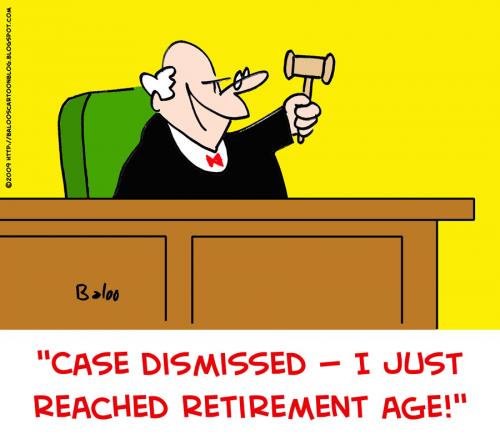
Case Dismissed. I've just reached my retirement age, via ToonpoolsIn my last post, I mentioned that the question of the compatibility of mandatory retirement ages with EU law was pending before the European Court of Justice (ECJ). The Court has now handed down its decision, upholding the principle of mandatory retirement ages, but requiring them to be justified on a high standard of proof.

The case, C-388/07 R (on the application of The Incorporated Trustees of the National Council on Ageing (Age Concern England)) v Secretary of State for Business, Enterprise and Regulatory Reform, was a reference from the High Court (Queen’s Bench Division, Administrative Court), for a preliminary ruling concerning the interpretation of Council Directive 2000/78/EC (pdf) of 27 November 2000 establishing a general framework for equal treatment in employment and occupation (OJ 2000 L 303, p16), which had been transposed in the UK by the Employment Equality (Age) Regulations 2006 (SI No 1031 of 2006). The Directive and the Regulations provided for a general principle of non-discrimination on the grounds of age. However, they allowed for exceptions that are objectively and reasonably justified by a legitimate aim, provided that the means of achieving that aim are appropriate and necessary (see, eg, Article 6(1) of the Directive). On this basis, Regulation 30(2) allowed for a derogation from that general principle in the context of compulsory retirement at 65. Age Concern (the UK’s equivalent of Age Action) challenged that derogation on the grounds that the derogation did not meet the requirements of Article 6(1), but the ECJ rejected that challenge: Read the rest of this entry »

Comments 1 Comment »

Old Lawyers, via carbolic smoke ball site.The issue of compulsory retirement is not an uncommon one, but it arises today in an uncommon context. From today’s Times Online,

Judges take on Ministry of Justice over age discrimination

Two judges this week have launched a discrimination claim against the Ministry of Justice over being forced to retire at 70. … The claim is only the latest of several challenges by judges or lawyers over compulsory retirement. …

An earlier Times Online article reported that senior UK judges are pressing for a change in the law to allow the most senior members of their profession to remain in their posts beyond the age of 70.

This all recalls for me the words of Lord Bridge of Harwich in Ruxley Electronics & Construction Ltd v Forsyth [1996] AC 344, [1995] UKHL 8 (29 June 1995):

My Lords, since the populist image of the geriatric judge, out of touch with the real world, is now reflected in the statutory presumption of judicial incompetence at the age of 75, this is the last time I shall speak judicially in your Lordships’ House. I am happy that the occasion is one when I can agree with your Lordships still in the prime of judicial life who demonstrate so convincingly that common sense and the common law here go hand in hand.

Read the rest of this entry »

Comments 8 Comments »

Creative Commons Attribution-NonCommercial-ShareAlike 3.0 Unported
This work by Eoin O Dell is licensed under a Creative Commons Attribution-NonCommercial-ShareAlike 3.0 Unported.