Archive for the “UK Supreme Court” Category

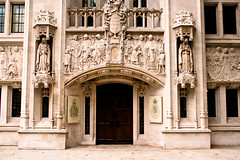
Image of UK Supreme Court building, via the UKSC blogNo, not the Irish Supreme Court, but the new UK Supreme Court. There’s quite a lot of coverage in the UK media and blawgopshere today about the new Court at the apex of UK’s judicial system, which opens for business today, on time and on budget, in a refurbished former criminal court, after a difficult gestation. David Pannick argues in the Times today that, however unhappy its origins, the opening of a new Supreme Court is an important commitment to the rule of law. Much of the media interest turns on the fact that the Court will be televised. For example, one of the pieces in the Times is headlined that TV coverage means justice really will be seen to be done:

The reform has taken a number of steps over 20 years: a Bar Council report chaired by Jonathan Caplan, QC, in 1989, the filming of parts of the Shipman inquiry and the Hutton inquiry and the 2004 pilot project in the Court of Appeal all moved the issue of cameras in court forward. … The footage will be filmed and recorded by the court and made available by a feed to broadcasters, … [and] can be used only for news, current affairs and educational and legal training programmes.
Read the rest of this entry »

Comments 1 Comment »

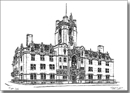
The Supreme Court at the Guildhall, by Stephen Wiltshire via his siteAs the slow march towards a new Supreme Court for the UK nears its destination, the Times has a piece about its newly refurbished premises:

The United Kingdom’s new Supreme Court will open its doors for business on October 1, with the first inbuilt facilities in Britain for broadcasting in court. … Broadcasting and internet arrangements are still to be devised but the three courts (two for the Supreme Court, one for the judicial committee of the Privy Council) can be filmed, a first in England and Wales.

As the BBC story on the completion of the refurbishment emphasises, the “decision to televise events from inside the court’s three chambers is a first for England and Wales”. And the Guardian quotes Jenny Rowe, the Court’s Chief Executive as saying that they are “in advanced discussions with broadcasters about the material they will want to use … If broadcasters wish to show it we will make it available”.

I think that it is a splendid idea. As the Canadian blawgs Slaw and the Court point out, since February 2009, the Supreme Court of Canada has provided live streaming of oral arguments and judges’ questions in authorized cases. The whole experiment is working well, and doing the same in the UK is an excellent development. When will the Irish Supreme Court follow suit? Will it ever catch on here? It can only help to promote public confidence in the administration of justice at the highest level. After all, not only would justice be done, it would be seen to be done.

Comments 1 Comment »

Jeremy Bentham auto-icon, via UCLJeremy Bentham (1748-1832) (left) was a utilitarian philosopher, whose radical ideas on education inspired those who founded University College London. Nowadays, the Bentham Association (formerly the Bentham Club) is the Alumni Association for UCL’s lawyers, and it annually hosts a Presidential Address from an invited senior lawyer. This year’s address was given by Lord Pannick QC on the topic:

“Better that a horse should have a voice in that House [of Lords], than that a judge should” (Jeremy Bentham).

Replacing the Law Lords by a Supreme Court

It broadly concerned the implications of the removal of the final court of appeal from parliament, and can be heard online here. It covers a wide range of very interesting material, and is very well worth listening to. There’s no text yet online, but one aspect of it appears in Pannick’s column in today’s Times, taking the field on an issue I’ve looked at already on this blog (here and here); some extracts:

Seventy is far too early for a supreme court judge to retire . . .

… The argument for a retirement age of 75 for all supreme court justices is very simple. Those appointed are the cream of the judiciary. They inevitably take time to rise to the top, normally after serving for several years in the High Court and then in the Court of Appeal. It seems an awful shame to throw out judicial resources of such quality after a short stay in the supreme court when they are still fresh in mind and body and well short of their sell-by date.

… One can sympathise with the comments of Lord Bridge of Harwich in his final case in the Appellate Committee in 1995 when he expressed his annoyance at “the statutory presumption of judicial incompetence at the age of 75”. Lord Bridge, still at the peak of his considerable intellectual powers, went off to study for a mathematics degree.

… The appropriate balance between innovation and experience (or, if you prefer, between immaturity and senility) is, I think, a retirement age of 70 for judges of the High Court and the Court of Appeal. But for the supreme court, given the length of time that it will take for judges to arrive at such legal heights, a retirement age of 75 is more appropriate. Lords Reid, Wilberforce and Bingham of Cornhill, whose intellectual force, constitutional perspective, and good sense adorned the Appellate Committee of the House of Lords over the past 40 years, did much of their best work after 70. It would be a great detriment to the legal system if their successors were prematurely retired to a life as arbitrators.

On this one, I’m with Pannick, but I’m not sure Bentham would have approved: he didn’t trust judges much.


Update: joining Pannick’s column in the Times Online is the following related news story:

Judges fail in Tribunal bid to extend working lives beyond 70

Two judges fighting to work beyond the age of 70 have lost their case, the Tribunals Service has said. … The decision coincides with a move by legal peers to enable Britain’s top judges – those appointed to the new Supreme Court in the autumn – to stay on until the age of 75. …

I’ve blogged about the judges’ age discrimination challenge already; what I find most interesting is the throwaway line in the article that legal peers are lining up to support a retirement age of 75.

Comments 5 Comments »

Creative Commons Attribution-NonCommercial-ShareAlike 3.0 Unported
This work by Eoin O Dell is licensed under a Creative Commons Attribution-NonCommercial-ShareAlike 3.0 Unported.