Archive for the “Law” Category

Crash test dummy, accident, via the BBC.There may – controversially – be no duty to rescue at common law (see, eg, Alan Calnan (SSRN), David Hyman (pdf)), but the emergency can beget the man (Wagner v International Railway 232 NY 176 (1926) (Cardozo J)), even in New York. However, although danger may very well invite rescue (Wagner (Cardozo J) again), nevertheless, it seems that it would now be wise to decline the invitation in California. From Ratio Juris:

… The California Supreme Court has given fresh meaning to “no good deed goes unpunished.” It ruled last week that a woman who yanked a co-worker from a crashed car four years ago, and may have made her injuries worse, can be sued because what she did wasn’t medical care. …

The best conceptual discussions are EJ Weinrib “The Case for a Duty to Rescue” (1980) 90 Yale Law Journal 247 and the very different WM Landes and RA Posner “Salvors, Finders, Good Samaritans and other Rescuers: An economic study of Law and Altruism” (1978) Journal of Legal Studies 83 (SSRN); for Irish law on the point, see “Danger Invites Rescue. The Tort of Negligence and the Rescue Principle” (1992) 14 Dublin University Law Journal 65.

Why do I have the urge to hum the Dionne Warwick/Burt Bacharach/Hal David song “Walk on by“?

Comments 2 Comments »

New English judicial robes, via Slaw; as the image has been moved somewhere else on the official UK judiciary websiteI wrote a little while ago about plans for most civil judges in England and Wales to cease wearing wigs, wing collars and bands, and to wear radically simplifed judicial gowns. The change was to come into effect from 1 January 2008, but it was postponed until 1 October because because an insufficient number of gowns had been made in time. The revised deadline was met, and from this month, judges in civil and family courts will wear the new dark blue gaberdine robe with velvet facings (right). The colour – gold, red or lilac – of the strips of cloth under the chin (which to my eye recall the eliminated tapes) indicate the level of judge. The designs, by Betty Jackson, raised some controversy when they were first announced, but they seem fine (if unexciting, and distinctly civilian rather than alien) to me. Read the rest of this entry »

Comments 6 Comments »

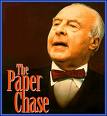
Eagle -eyed readers may have noticed the recent addition of a law news feed on the top of the right side bar; it’s called Paper Chase, and it provides Jurist headlines updated every 15 minutes or so. I presume it gets its name from the novel (1970, reissued 2004), movie (1973) and television series (1978-1978, 1983-1986) of that name. I was reminded of this wonderful cultural insight into elite US law schools by a post by David Papke on the Marquette University Law School Faculty Blog:

The Paper Chase: What Does the Film Tell Us About Contemporary Legal Education?

I recently screened The Paper Chase (1973) in one of my law school classes. While the majority of current law students are more familiar with recent pop cultural portrayals of legal education such as Legally Blonde (2001) [imdb], The Paper Chase seems to me to set the stage for those portrayals, especially through the character of Professor Kingsfield [wikipedia] and the images from his menacing Socratic classes. I interpret The Paper Chase as the fictional story of a law student encountering and then overcoming the dehumanizing forces of legal education.

My students resisted this interpretation and proffered two other readings. Some thought The Paper Chase should be recognized as a largely accurate portrayal of the realities of legal education. … Other students interpreted The Paper Chase as a positive portrayal of legal education, as a suggestion that law school could and should toughen students and separate those who “had it” from the mere posers. One student said she regretted her legal education was not more like the one portrayed in The Paper Chase. …

Read the rest of this entry »

Comments 4 Comments »

NRA logo, via its website.Every citizen should be a soldier. This was the case with the Greeks and Romans, and must be that of every free state.

For a people who are free, and who mean to remain so, a well-organized and armed militia is their best security.

In 1972, the Supreme Court of the United States decided Roe v Wade 410 US 113 (1973) (Findlaw | Justicia | Oyez | wikipedia), which held the Due Process Clause of the Fourteenth Amendment to the US Constitution protects the (penumbral) right to privacy, including a woman’s qualified right to terminate her pregnancy. It was a controversial decision which demonstrated that the Court was at the vanguard of the dominant public political mood. The Court was sharply divided; the case was decided on the basis of contestable constitutional theory; and it has subsequently given rise to a huge amount of analysis and scholarship, as well as much partisan social commentary and political scheming.

In 2008, the Supreme Court of the United States decided US v Heller 554 US __ (2008) (official pdf | Findlaw report) (Balkinization | Mike O’Shea on Concurring Opinions | NRA | Posner | ScotusWiki | Volokh | Wikipedia), which held that the Second Amendment to the US Constitution protects an individual right to possess a firearm unconnected with service in a militia, and to use that arm for traditionally lawful purposes, such as self-defense within the home. As with Roe, it, too, was a controversial decision which demonstrated that the Court was at the vanguard of the dominant public political mood. Again, the Court was sharply divided; the case was decided on the basis of contestable constitutional theory; and it has already given rise to a huge amount of analysis and scholarship, as well as much partisan social commentary and political scheming.

But there is one obvious difference between the two cases: whereas Roe stands as the highpoint of liberal judicial activism and reflects a then quite dominant liberal political perspective, Heller stands as a similar highpoint of conservative judicial activism and reflects a now very marked conservative political perspective.

These similarities and differences raise some important questions. For example, Roe became a rallying-point for legal, social and political opposition (update: backlash) to judicial and political liberalism; will Heller become a similar rallying-point for legal, social and political opposition to judicial and political conservatism? Moreover, views on the correctness of Roe have become a litmus test for Republican nominees to the Court; will Heller similarly become a litmus test for Democratic nominees to the Court?

Finally, if (and when?) there is a majority on the Court to reverse Roe, will they do it? Or will they baulk at such a naked exercise of judicial-political power? Or are there other judicial/political considerations afoot? Or will they realise that to overrule Roe simply because they disagree with its political underpinning would be to eviscerate the doctrine of precedent? If they do overrule Roe, then every decision of the Court is up for grabs, even the case that overrules Roe, and yes, even Heller!

Comments 4 Comments »

CAIDA orb logo, via their site.kc claffy, of the Cooperative Association for Internet Data Analysis (CAIDA) at the San Diego Supercomputer Center of the University of California, San Diego has a blog post (hat tip: David) under the above heading:

Last year kc claffy was invited to give a 15-minute vignette (at the Supernova 2007 conference) on the challenge of getting empirical data to inform telecom policy. Following the conference, she was invited to attend a meeting in March 2008 hosted by Google and Stanford Law School — Legal Futures — to convey the most important data points she knew about the Internet to lawyers thinking about how to update legal frameworks to best accommodate information technologies in the 21st century. With a couple months of more thought, kc has come up with a comprehensive list of the top ten most important things lawyers need to understand about the Internet.

It is fascinating to have the techie view on research relating to the internet written from that perspective but with an eye to a legal (and policy) readership. She has provided ten link-rich, punchy and informative posts which every lawyer and policy-maker should read. Read the rest of this entry »

Comments 2 Comments »

Times MastheadFrom an article in The Times by Alex Wade (who blogs as Surf Nation):

Legal blogs: isn’t it time British lawyers staked their claim in the blogosphere?

Should law firms have blogs? In America they are all the rage. Just about every self-respecting law professor has one, many firms believe them to be a must-have accoutrement, and even one or two judges have got in the act.

In Britain only a handful of legal practitioners maintain blogs, but as society increasingly embraces the Web 2.0 world of interactivity, collaboration and social networking, isn’t it time that UK firms staked their claim in the blogosphere? …

It may be, too, that the embedded right to freedom of expression in American society, in contrast to Britons’ tendency to discretion (exemplified, arguably, in our highly developed libel laws), is another factor in transatlantic enthusiasm for the blogosphere.

I’m sure exactly the same questions can be asked in Ireland. Read the rest of this entry »

Comments No Comments »

0. Prolegomenon, or Why me?
Early cover of Ulysses, via James Joyce Centre website.Today is Bloomsday, the centrepiece of a weeklong festival in Dublin celebrating the day in 1904 on which the events of James Joyce’s novel Ulysses unfold, which is the day Joyce first formally went out with Nora Barnacle (the story is told in the enthralling movie Nora; other movies with 16 June references include The Producers and Before Sunrise). In the novel, all human life is there; and Eamon Fitzgerald’s Rainy Day is currently by far the best guide to the important things in life: democracy, football, and technology. Expect a Bloomsday post today (this is last year’s; update: this is this year’s). Just like Oh Brother, Where art Thou?, the novel loosely parallel’s Homer’s Odyssey, and this blogpost will very very loosely parallel Joyce’s Ulysses (or at least his chapter headings). Read the rest of this entry »

Comments 13 Comments »

Heads, from TCD Research and Innovation Site.In Ireland, the law relating to patents is governed by the Patents Act, 1992 (here and here) as amended in 2006 (here and here). According to the Irish Patents Office, a patent

confers upon its holder, for a limited period, the right to exclude others from exploiting (making, using, selling, importing) the patented invention, except with the consent of the owner of the patent. A patent is a form of ‘industrial property’ [IP], which can be assigned, transferred, licensed or used by the owner.

The same site also clarifies that any person

may make an application for a patent; the right to a patent belongs to the inventor or the inventors’ successor in title. However, if an employee makes an invention in the course of his/her employment the right to the patent may belong to the employer.

Unsurprisingly, therefore, my employer (Trinity College Dublin) claims ownership

… of all IP created by College Staff in the course of their employment and/or in the fields of expertise in which they choose to work, and thus inventors are required to assign their rights to the College through Innovation Services. In return for this assignment, College contracts with the creators of the IP to share with them any financial benefits received, in accordance with College Regulations.

However, the cat [not this one] has been well and truly thrown among the pigeons by an Australian decision, on similar legislation, by French J in Federal Court of Australia in University of Western Australia v Gray (No 20) [2008] FCA 498 (17 April 2008), a case greeted thus by today’s Sydney Morning Herald:

Universities shudder over patent ruling

EMPLOYERS’ claims on patents for inventions made by their staff may be under threat after a landmark Federal Court ruling in a case pitting the University of Western Australia against one of its former academics, Sirtex founder Bruce Gray. … The case arose after Dr Gray, a professor of surgery, developed a promising new liver cancer treatment while working as an academic at the university. Dr Gray then left to form a biotechnology company, Sirtex, which included some of his intellectual property among its assets when it floated in 2000.

Four years later UWA started legal proceedings against Dr Gray for wrongly appropriating the intellectual property, but this month the judge found in his favour in a decision that pivoted on the professor’s obligations as a university employee.

“Absent express agreement to the contrary, rights in relation to inventions made by academic staff in the course of research and whether or not they are using university resources, will ordinarily belong to the academic staff,” Justice French said.

“The position is different if staff have a contractual duty to try to produce inventions. But a duty to research does not carry with it a duty to invent.” …

Unsurprisingly, the University has said that it is considering an appeal.

Now, if only I had a patentable invention, I could see just how robust the TCD policy is …

Comments 2 Comments »

Creative Commons Attribution-NonCommercial-ShareAlike 3.0 Unported
This work by Eoin O Dell is licensed under a Creative Commons Attribution-NonCommercial-ShareAlike 3.0 Unported.