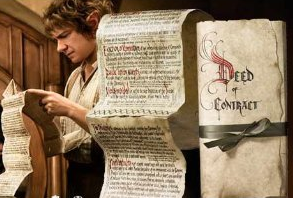
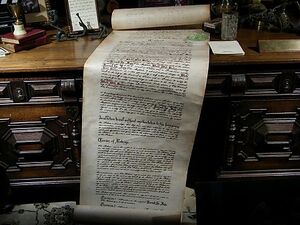
Warning: plot spoilers When the movie begins, our hero, Shrek, is suffering a classic mid-life crisis; he is dissatisfied with married life, and pining for the old days, when he was a terrifying ogre rather than a domesticated tourist attraction. Rumpelstiltskin, the evil and manipulative magic deal-maker, offers Shrek the opportunity to spend a day as a real ogre again, in return for another day from Shrek’s childhood. The YouTube clip at the top left is the scene in which Rumpelstiltskin cajoles Shrek into agreeing. Having signed on the dotted line, Shrek is transported into an alternate reality. At first, he enjoys being fearsome one again. But the catch – and there’s always a catch – is that the day Rumpelstiltskin takes is the day of Shrek’s birth. This means that Shrek was not there to rescue Princess Fiona in the first movie; and her desperate parents, King Harold and Queen Lillian, turned to Rumpelstiltskin, and signed over the kingdom of Far Far Away to him in return for having all of their problems disappear. They disappeared, and the kingdom is now subject to Rumpelstiltskin’s tyrannical rule. It is a world where ogres are hunted criminals and Fiona leads the resistance; and when Shrek’s day as a frightening ogre is over, it will all be as if he had never existed. However, Donkey reveals to Shrek a sneakily-hidden exit clause in his contract with Rumpelstiltskin: if Shrek receives “True Love’s First Kiss”, the contract will be rendered null and void. So, the third act of the movie turns on Shrek’s efforts to get Fiona to fall in love with him and kiss him before the morning.
This time last year, I found myself explaining to concerned parents at the Higher Options Fair that law students’ small lecture load does not necessarily mean a small work load. Plus ça change. My colleagues have found themselves explaining much the same thing today at this year’s event. Briefly, law students should spend considerable amounts of time on independent reading, developing research skills (how to find what is relevant) and honing discernment and judgment (how to decide what to use of what is read) – these are all important practice skills which they learn in college.
In the US, the Socratic Method is widely used in Law Schools to teach these skills, and it is one of the driving dramatic forces in The Paper Chase, a book/movie/tv series on which I have already commented here and here. Its great character was John Houseman’s inconic Contracts Professor, Charles Kingsfield – the clip below is the first time we meet him in the tv series:
The case being discussed in the clip is Hawkins v McGee 84 N.H. 114, 146 A. 641 (Supreme Court of New Hampshire, 1929), and Kingsfield’s victim is James T Hart, the confused first year law student, played by Timothy Bottoms, who is the central character in the series. But even though the series is nominally about Hart, as Tim Zinnecker recently commented on The Faculty Lounge, Houseman’s Kingsfield steals the show in every scene in which he appears. Timothy Burke on Easily Distracted acknowledged that calling students up on the carpet in an imperious Professor Kingsfield fashion is a beautiful style of teaching when done well (though he preferred the approach of his high school English teacher, who taught with passion). Kingsfield’s literary creator, the author John Jay Osborn Jr, noted A Change in Professor Kingsfield–and His Creator: over the course of book/movie/tv series, he grew more complicated. Todd J. Zywicki on the Volokh Conspiracy posed the question Who Was the Basis for Professor Kingsfield?, and The Faculty Lounge adds a few more candidates to the list. Moreover, in a tribute to the character’s enduring appeal, Michael Vitiello has written a full law review piece about him: “Professor Kingsfield: The Most Misunderstood Character in Literature” 33 Hofstra Law Review 955 (2005) (pdf). Indeed, in what was no doubt an intentional reference, the 2002 movie The Socratic Method (imdb), about first year law students in a fictional California law school, features a Professor Houseman.
My continuing mission is to become like Kingsfield every day. I teach Contract. That’s a start.
The United Kingdom’s new Supreme Court will open its doors for business on October 1, with the first inbuilt facilities in Britain for broadcasting in court. … Broadcasting and internet arrangements are still to be devised but the three courts (two for the Supreme Court, one for the judicial committee of the Privy Council) can be filmed, a first in England and Wales.
As the BBC story on the completion of the refurbishment emphasises, the “decision to televise events from inside the court’s three chambers is a first for England and Wales”. And the Guardianquotes Jenny Rowe, the Court’s Chief Executive as saying that they are “in advanced discussions with broadcasters about the material they will want to use … If broadcasters wish to show it we will make it available”.
I think that it is a splendid idea. As the Canadian blawgs Slaw and the Court point out, since February 2009, the Supreme Court of Canada has provided live streaming of oral arguments and judges’ questions in authorized cases. The whole experiment is working well, and doing the same in the UK is an excellent development. When will the Irish Supreme Court follow suit? Will it ever catch on here? It can only help to promote public confidence in the administration of justice at the highest level. After all, not only would justice be done, it would be seen to be done.
In his review essay on Star Trek: The Exhibition [link], Edward Rothstein [wikipedia] points out a number of anachronisms and anamolies, most stemming from the original television series and its spin-offs. He notes that mixing reality and pop culture may do neither justice. Points taken. (I saw this exhibition in San Diego). For those of us who grew up on ST: TOS and its offspring and who are fond of the Star Trek mythos, however, this show doesn’t represent the reality or history of space flight. But that, as I understand it, isn’t really the point of Star Trek: The Exhibition. The point is to examine the effect of the show on the generations who have watched and grown up with the show, and the effect of those viewers on Star Trek. See also the program (available on DVD) How William Shatner Changed the World [imdb], based on his book I’m Working On That: A Trek From Science Fiction To Science Fact (2004) [Amazon].
Can one exhibition capture all of that involvement and energy? Probably not. Many people have written books attempting to measure these effects. But this particular exhibition at least allows some of us to examine the evidence.
After what has seemed to most Contracts professors an unconscionably long time, the TV series The Paper Chase has finally come out on video. Technically, it's called "season one" although there was only one season on the original CBS program in 1978-79. Three additional seasons were run on Showtime starting in 1983, which allowed the protagonist, "Mr. Hart," to graduate Harvard in only four years.
On the Amazon web site (linked above) you can see a riveting clip dealing with (among other things) whether one who performs the service requested by a reward offer can recover if he was unaware of the reward. The growing tension among the students who offer different answers is . . . palpable.
I have already glanced at the legal issues in The Merchant of Veniceon this blog; but Shakespeare dealt with issues of justice and mercy in many other plays as well. Consider for example Measure for Measure (wikipedia | full text | Project Gutenberg), which juxtaposes imperfect justice on earth with merciful justice in heaven. Christine Corcos on the Law and Humanities Blog writes about a fascinating analysis of the play from a legal perspective (with added links):
John V. Orth, University of North Carolina, Chapel Hill, School of Law, has published “‘The Golden Metwand’: The Measure of Justice in Shakespeare’s Measure for Measure,” in the Adelaide Law Review. Here is the abstract.
Measure for Measure, one of Shakespeare’s problem plays, is a dark comedy depicting Duke Vincentio’s effort to restore respect for the law after a period of lax enforcement. Peopled with a wide variety of law-enforcers and law-breakers, the play implicates numerous legal issues and has consequently attracted the attention of lawyers and judges. In the eighteenth century Sir William Blackstone contributed notes on the play, while in the twentieth century judges have quoted from it in their judicial opinions. Like all good legal dramas, Measure for Measure ends with a trial scene, but – as we would expect from Shakespeare – one with an unusual twist. When charges of corruption are brought against Angelo, the deputy appointed to enforce the law, the Duke orders an immediate trial: Come, cousin Angelo / In this I’ll be impartial; be you judge / Of your own cause. When the deputy’s guilt is disclosed, the Duke commands that he suffer the punishment he intended for others – measure for measure, putting the Bible-conscious play-goer in mind of the passage: Judge not, that ye be not judged. / For with what judgement ye judge, ye shall be judged, and with what measure ye mete, it shall be measured to you againe. By ordering Angelo to be the judge of his own cause, the Duke is inviting the deputy to measure out his own punishment. And Shakespeare is forcing us all to confront the difficulty of doing earthly justice.
Scene II, the Sermon on the Mount, from the perspective of back of the crowd, where Jesus can barely be heard over the hubub:
GREGORY: What was that? … MAN #1: I think it was ‘Blessed are the cheesemakers.’ … MRS. GREGORY: Ahh, what’s so special about the cheesemakers? GREGORY: Well, obviously, this is not meant to be taken literally. It refers to any manufacturers of dairy products.