Archive for the “Blasphemy” Category

In The Godfather, Part III, Michael Corleone (played by Al Pacino) laments

Just when I thought I was out… they pull me back in.

I know how he feels (though without the mafia connections, obviously). I had intended yesterday’s post to be my last on blasphemy for some time, but then Eoin Daly, a PhD student in UCC, went and spoiled it all by writing an excellent guest post on CCJHR blog about the new offence; update and Michael Walsh, a law student at NUI Galway, has written a compelling post critiquing some of my earlier analysis on the issue. To being, some extracts from Eoin’s post:

The Pluralisation of Blasphemy law: Possible Constitutional Implications

Image of UCC Quad, via the UCC Law Faculty website… the most interesting aspect of the new offence [is] the fact that is has been “pluralised”, encompassing material that is “grossly abusive or insulting in relation to matters held sacred by any religion.” … blasphemy law has shifted from a religious to a secular legitimation, from the protection of a particular religious truth, to the protection of the sentiments of religious persons, of all recognised affiliations.

However, it is this very fact of a secular legitimation, of “outrage among a substantial number of [any religion’s] adherents”, which renders the contours of the offence unfeasibly vague. Read the rest of this entry »

Comments 4 Comments »

Blasphemy - The road to Hell has never been funnier.It’s a pity that Part 5 of the Defamation Act, 2009, relating to blasphemy, has dominated the coverage of the Act at home and abroad (eg, US, Denmark (pdf)), since the legislation does considerably more than that. It is radical modernisation of Ireland’s defamation laws, and is a vast improvement on what had gone before. In particular, it provides several means to ensure much speedier resolution of defamation cases; it provides for a new defence of reasonable publication; it significantly improves the law relating to damages in defamation cases; and it gives a stable statutory footing to the Press Council. These will be matters to which I will return on this blog; but, before that, I want to make another comment about Part 5 of the Act.

Part 5 of the Act consists of three sections. Section 35 abolishes the common law offences of defamatory libel, seditious libel and obscene libel are abolished. Section 36, subsections (1)-(2) create the new crime of blapshemy, by making it an offence to cause outrage among a substantial number of the adherents of a religion by intentionally publishing material that grossly abuses or insults matters held sacred by their religion. This is narrowed in two ways: subsection (3) provides a saver for publications of genuine literary, artistic, political, scientific, or academic value; and subsection (4) excludes from the definition of “religion” an organisation which principally aims to make a profit or which employs oppressive psychological manipulation. Finally, where there has been a conviction, section 37 (probably impotently) allows for the seizure of blasphemous matter.

This Part of the Act was introduced very late in the day, and was the subject of limited debate in the Oireachtas, but it is not a unique provision. Moreover, as I have already said, it is neither a trap for the unwary, nor a charter for religious cranks, nor even a check upon valuable public discourse; but there are still many problems with it. Read the rest of this entry »

Comments 3 Comments »

Monkey at a typewriter, via Wikipedia.On the monkeys-and-typewriters principle, I suppose it was inevitable that Kevin Myers would eventually write something with which I would agree. He did, today, in the Irish Independent:

I have the right not merely to offend people, but to intend to

… The Ahern law on blasphemy must be the first law ever whose instigator is desperately hoping that it will never be invoked. Its potency depends not upon any legal definition on what blasphemy actually consists of, but solely on the “outrage” that the remark in question might intentionally cause.

… Well, frankly, I think I have the right not merely to offend people, but the right to intend to do so. It is up to them, and their personal capacity to control their emotions, as to whether or not they are outraged. …

Polemical as always, and trenchant, he is making much the same point as I essayed here and here.

On the same principle, it was probably just as inevitable that I would at some stage feel a little sorry for Gerry Ryan. I did, today, when I learned that he had been the subject of a complaint to the Broadcasting Complaints Commission for wondering whether it would be considered blasphemous if someone said on air that “God is a bollocks”. The BCC rejected the complaint (see decision here – warning .doc), and quite right too. Even though he was obviously courting controversy for the remark, I felt sorry for him that he had to spend some time defending himself to the BCC against such a silly complaint.

Finally, via Gerard Cunningham’s 200 words, I learn that the Bishop of Cork, Cloyne and Ross, the Right Reverend Paul Colton, via his Twitter account, recently asked:

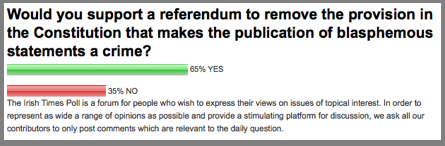
Can we start a campaign now to have a referendum on the removal of the reference to blasphemy from the Irish Constitution?

Hear, hear


Bonus links: also in the Irish Independent Opponents to continue fight after blasphemy made illegal. See also Irish Examiner here and here | Irish Times here and here | Paddy McKenna here and here.

Comments 2 Comments »

President McAleese via WikipediaFrom the Irish Times breaking news site:

President McAleese signs controversial Bills into law

President Mary McAleese has this morning signed the Defamation Bill 2006 and the Criminal Justice (Amendment) Bill 2009 into law. …

Updates: from RTÉ news: President signs controversial bills into law; and from the Irish Times: Ahern welcomes Bills’ enactment; see also Belfast Telegraph | BreakingNews.ie | CCJHR blog | IrelandOnline | Irish Election | New Humanist | New York Times | Press Association | Slugger O’Toole | Tribune.ie. Further update: it’s now listed on the official list of Acts signed by President McAleese, as the Defamation Act, 2009 (No 31 of 2009) / An tAcht Um Chlúmhilleadh, 2009 (Uimhir 31 de 2009).

In a press release, the Minister for Justice welcomed both enactments, and he had this to say about the new Defamation Act, 2009:

Modernisation of our Defamation law is now complete on the enactment of the Bill. I believe the legislation in what is a complex area strikes the right balance in the public interest.

For Michael Nugent, the campaign to repeal the new blasphemy law begins now.

Comments 5 Comments »

Patience image, via AmazonFor anyone who is as impatient as I am to find out what President McAleese has decided after her meeting this evening with the Council of State, the RTÉ News website is reporting:

The meeting of the Council of State called by the President ended at around 10pm. … The President has indicated she will announce her decisions tomorrow morning. …

Update (23 July 2009): Irish Independent | Irish Times here and here | Jason Walsh here and here | Slugger O’Toole.

And so we wait. Patiently?

Bonus link: meanwhile, the RTÉ news report has a link to the following story from a few weeks ago: OSCE argues against blasphemy law. The Organization for Security and Co-operation in Europe (OSCE) press release to which that story refers is headed: OSCE media freedom representative welcomes Irish draft law decriminalizing libel, asks to drop ‘blasphemous libel’, and begins (with added links):

The OSCE Representative on Freedom of the Media, Miklos Haraszti, welcomed today the Irish Parliament’s final preparations to decriminalize defamation, but warned that the proposal to introduce a new article on ‘blasphemous libel’ risked jeopardizing OSCE media freedom commitments. …

Comments 1 Comment »

Cover of Levy's book on Blasphemy, via the publishers' website.In today’s Irish Times, a piece by yours truly under the above headline:

Blasphemy provisions clash with Constitution

The President has very few unconstrained powers, and the Council of State is convened only rarely, but this evening they will all move centre stage, when the Council convenes to advise the President whether to refer two controversial Bills to the Supreme Court. Whatever she does about the Criminal Justice (Amendment) Bill, 2009, she should certainly refer the blasphemy provisions of the Defamation Bill, 2006 …

Read all about it here (it’s a development of my argument here).

The cases I mention in the piece are:

  • the case against Gay News magazine (wikipedia) is Whitehouse v Lemon [1979] AC 617 (HL) (wikipedia);
  • the case against Salman Rushdie for The Satanic Verses is R v Metropolitan Magistrate ex p Choudhury [1991] 1 QB 429;
  • the case against Jerry Springer – The Opera is R (on the application of Green) v The City of Westminster Magistrates’ Court [2007] EWHC 2785 (Admin) (05 December 2007);
  • the relevant decisions of the European Court of Human Rights include Wingrove v UK 17419/90 [1996] ECHR 60 (25 November 1996), and Klein v Slovakia 72208/01 [2006] ECHR 909 (31 October 2006); and
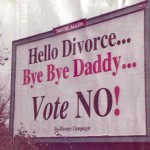
  • the case against the Sunday Independent for publishing the divorce referendum cartoon is Corway v Independent Newspapers [1999] 4 IR 485; [2000] 1 ILRM 426; [1999] IESC 5 (30 July 1999).
  • Comments 2 Comments »

    Áras an Uachtaráin = Residence of the President of Ireland, via the President's siteThe saga of the Defamation Bill, 2006 is not over yet. Article 26 of Bunreacht na hÉireann (the Irish Constitution) allows the President, after consultation with Council of State, to refer a Bill to the Supreme Court for a determination of its constitutionality. President McAleese has chosen to convene the Council of State to advise her on the qustion of whether to refer not only the (controversial) Criminal Justice (Amendment) Bill, 2009 (an unsurprising move) but also the (equally controversial) blasphemy elements of the Defamation Bill, 2006 (which has come as a great surprise). (See Belfast Telegraph | BreakingNews.ie | Bock the Robber | ICCL | Irish Emigrant | Irish Independent | RTÉ news | Irish Times | PA | Slugger O’Toole. Update (18 July 2009): see also Irish Examiner | Irish Times here and here | Irish Independent | MediaWatchWatch).

    There have been 15 such references to date. If the Court holds that a Bill is unconstitutional, the President must decline to sign it; whilst if the Court decides a Bill is constitutional, the President must sign it into law, and the resulting Act is immune from constitutional challenge in the future. As my colleague Oran Doyle has pointed out, this means that

    … unlike in ordinary constitutional litigation, a decision made under the Article 26 reference procedure without consideration of a particular issue cannot be reopened when that issue is brought to light by another aggrieved litigant. … The tenor of the court’s reasoning in several references suggests that the court is more likely to hold legislation unconstitutional when the effect of its decision is absolute immunity for legislation considered only in the abstract.

    Admittedly, the reference procedure is imperfect (see, eg, Niamh Howlin “Shortcomings and anomalies: Aspects of Article 26″ (2005) Irish Student Law Review 26 (pdf)), but if it means that the odds are in favour of striking down the blapshemy provisions of the Defamation Bill, then bring it on!

    The last sentence of Article 40.6.1(i) of the Constitution provides that the publication or utterance of blasphemous material shall be an offence. In Corway v Independent Newspapers [1999] 4 IR 484 (SC), the Supreme Court declined to give any effect to the constitutional clause in the absence of a statutory provision, but that decision will be of little help in any Article 26 reference. Rather more recently, in R (on the application of Green) v The City of Westminster Magistrates’ Court [2007] EWHC 2785 (Admin) (05 December 2007) (discussed on this blog at the time), a Divisional Court of the English High Court held that it was the prevention of imminent public disorder probably which ensured the compatibility of the English common law offence of blasphemous libel with Article 10 of the European Convention of Human Rights:

    [17] … The Article 10(2) basis for the crime of blasphemous libel is best found, as it seems to us, in the risk of disorder amongst, and damage to, the community generally.

    The key question will be whether the influence of the Convention will mean that the Court will take a similar approach to the Constitution. Let us assume that it will. Section 36 of the Bill provides that

    (2) … a person publishes or utters blasphemous matter if—
    (a) he or she publishes or utters matter that is grossly abusive 10 or insulting in relation to matters held sacred by any religion, thereby causing outrage among a substantial number of the adherents of that religion, and
    (b) he or she intends, by the publication or utterance of the matter concerned, to cause such outrage.

    (3) It shall be a defence to proceedings for an offence under this section for the defendant to prove that a reasonable person would find genuine literary, artistic, political, scientific, or academic value in the matter to which the offence relates.

    Subsection (3) is a welcome saver, but the main question will be whether subsection (2) is constitutional. There is a large gulf between the outrage envisage by the subsection and the risk of public disorder envisaged by Green. If that case is right, then this provision must be questionable under the Convention; and if a similar approach is taken under the Constitution, then this provision must also be of dubious constitutionality. I will therefore await with great interest both the President’s decision and any subsequent decision of the Supreme Court. Of course, even if she decides not to refer either Bill, a constitutional challenge is likely the first time any of the controversial provisions are invoked. Either way, therefore, the blasphemy provisions of the Defamation Bill will get their day in court.

    Comments 12 Comments »

    Irish Times clock, image originally hosted on Irish Times websiteA Leader in today’s Irish Times welcomes the passing of the Defamation Bill, 2006, and argues that it will set an appropriate template for the practice of journalism in Ireland:

    The template for journalism

    The Defamation Bill has concluded its passage through the Oireachtas, with a few deserved wobbly moments on blasphemy, and now awaits the signature of President McAleese. It will set the template for the practise of journalism in the years ahead. …

    The new regime for journalism will operate on twin pillars. The Bill attempts – quite successfully – a balancing of constitutional rights: between the public’s right to know and the citizen’s right to a good name. … The concession to the practise of journalism is the new defence of “reasonable publication” allowing newspapers to publish stories of public importance for the public benefit if they can be shown to have been thoroughly investigated and done in good faith – even if allegations made in them turn out to be untrue.

    The quid pro quo for these changes is the Office of Press Ombudsman and an independent Press Council which are given legal privilege for their findings in the Bill. These offices give readers a formal and free complaints system which has been in operation for more than a year. The Irish Times supports them wholeheartedly. They face a huge challenge to stem the slide in standards in Irish journalism. …

    Read all about it here.

    Comments 1 Comment »

    Creative Commons Attribution-NonCommercial-ShareAlike 3.0 Unported
    This work by Eoin O Dell is licensed under a Creative Commons Attribution-NonCommercial-ShareAlike 3.0 Unported.