A Jewish moneylender in Renaissance Venice, Shylock had made a loan to Antonio, in default of which he would entitled to a pound of Antonio’s flesh. Antonio defaulted, and Shylock sought specific performance. But, after Portia’s advocacy on behalf of Antonio, the Duke of Venice ruled that Shylock was entitled to a pound of flesh but not a drop of blood, and refused both specific performance and damages in lieu. More than that, for seeking to take Antonio’s life, Shylock was disgraced and forced to convert to Christianity, and his property was forfeit (though half was ultimately settled upon his daughter Jessica, who had converted to Christianity and eloped with her suitor, Lorenzo). Read the rest of this entry »
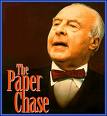
Eagle -eyed readers may have noticed the recent addition of a law news feed on the top of the right side bar; it’s called Paper Chase, and it provides Jurist headlines updated every 15 minutes or so. I presume it gets its name from the novel (1970, reissued 2004), movie (1973) and television series (1978-1978, 1983-1986) of that name. I was reminded of this wonderful cultural insight into elite US law schools by a post by David Papke on the Marquette University Law School Faculty Blog:
I recently screened The Paper Chase (1973) in one of my law school classes. While the majority of current law students are more familiar with recent pop cultural portrayals of legal education such as Legally Blonde (2001) [imdb], The Paper Chase seems to me to set the stage for those portrayals, especially through the character of Professor Kingsfield [wikipedia] and the images from his menacing Socratic classes. I interpret The Paper Chase as the fictional story of a law student encountering and then overcoming the dehumanizing forces of legal education.
My students resisted this interpretation and proffered two other readings. Some thought The Paper Chase should be recognized as a largely accurate portrayal of the realities of legal education. … Other students interpreted The Paper Chase as a positive portrayal of legal education, as a suggestion that law school could and should toughen students and separate those who “had it” from the mere posers. One student said she regretted her legal education was not more like the one portrayed in The Paper Chase. …
J.K. Rowling and her publisher [Bloomsbury / Scholastic] have launched an aggressive worldwide legal campaign against the unauthorized Potter takeoffs … [they] can use the courts in [TRIPS]/WTO-compliant countries to club her Potter rivals.
Now comes news from Legal Eagle on Skeptic Lawyer that Warners are taking on the might of Bollywood, seeking to restrain the distribution of an Indian movie called Hari Puttar – A Comedy of Terrors. Legal Eagle wonders “if they are going to attempt a breach of trademark claim? Or will it be a passing off claim?” Reflecting this, Skeptic Lawyer assets that it “couldn’t be copyright, as they’d skate by as ‘parody’.” Read the rest of this entry »
A wonderful video on YouTube seeks to teach the basic principles of copyright law using Disneycharacters. It’s very entertaining, and the legal analysis is pretty accurate. Perhaps Disney’s infamouslylitigious lawyers should have studied it, not for its potential breach of copyright, but for its content, since it seems that Disney might not in fact own some copyrights in their central character, MickeyMouse.
WaltDisney may be dead but thecorporation he left behind makes no secret of its intention to ensure Mickey’s worldwide legal immortality. To mangle Horace, this is one silly mouse that will produce mountains of law.
Athough most of the commentary focuses upon the obvious comic elements of the tale, there is actually a rather serious point. Read the rest of this entry »
It’s amazing how things come together sometimes. On the same day that I see an episode of Boston Legal in which an important sub-plot has a chronic gambler sue a Las Vegas casino for her losses, I read about two examples of life imitiating … well, if not art exactly, then at least entertaining television.
First, there was a story about a real-life US case in which a chronic gambler (a lawyer who should know better) is suing a Las Vegas casino for her losses. Perhaps she was influenced by this episode of Boston Legal? There, the gambling plaintiff won an excellent settlement (and the image above is of her really rather odd lawyers celebrating their unlikely victory, click on it – if you date – for more images from that episode).
in Calvert v William Hill Credit Ltd[2008] EWHC 454 (Ch) (12 March 2008) … Briggs J has declined to make a bookmaker liable for the economic loss suffered by a compulsive gambler who placed bets with them. On the facts a duty of care was owed (some interesting discussion of similar Australian cases) and the duty breached, but the claim failed on causation: the defendant only owed a duty to take care to ensure that the claimant implemented a self-exclusion arrangement, and even if this had been done, the claimant would have gone to another bookmaker and lost all his money there instead.
This does not bode well for the US plaintiff. Indeed, it is just another demonstration of the old adage that (in real life, whatever about on US television) the house always wins!
On Thursday 7 February 2008, Aois agus Eolais – the Centre for Ageing, Neuroscience and the Humanities will host a charity premiere of the extraordinary movie The Diving Bell and the Butterfly in aid of Stroke Research in the Adelaide and Meath Hospital Dublin, incorporating the National Children’s Hospital, Tallaght (AMNCH). It will begin with a reception at 6.30pm in the Atrium (map), Trinity College Dublin, followed by the screening at 8.00pm, Irish Film Institute (map), Eustace Street, Dublin 2. Subscription is €50, and further information and inviations are available from Catherine Talbot at 01 414 2432 or Marian Hughes at 087 286 4527.
The movie The Diving Bell and the Butterfly (official site | imdb | wikipedia) is based on the book Le scaphandre et le papillon by Jean-Dominique Bauby (amazon | NYT review | wikipedia), in which Bauby recounts the effects of a catastrophic stroke and weeks of deep coma from which he surfaced into “locked-in syndrome“, mentally alert but deprived of movement and speech, leaving the blinking of his left eyelid as his only means of communication. Directed by Julian Schnabel, the movie based on the book is shot from Bauby’s perspective, offering us views of his memories and imagination and his struggle to communicate and come to terms with his condition. It has won numerous international prizes and awards, including Best Director at the 2007 Cannes Film Festival and Best Foreign Language Film and Best Director in the recent 2008 Golden Globes. The proceeds of the premiere will be applied in particular to support the Music Therapy research project in the stroke service at the AMNCH.
This event is only the most recent in a long line of similar events by which Aois agus Eolais – the Centre for Ageing, Neuroscience and the Humanities has sought to promote a wider understanding of ageing in Ireland, especially among healthcare workers. The activities in the centre have included collaborations with the National Gallery of Ireland (pdf), the National Symphony Orchestra of Ireland, RTE Lyric FM, the School of Religions and Theology in TCD, the Institute of Art, Design and Technology, Dun Laoghaire (IADT), the Trinity College Institute of Neurosciences (TCIN), and the Trinity Centre for Bioengineering (TCBE).
Posted elsewhere (some of my recent posterous posts)
My posterous site is a companion to this blog: anything that catches my eye on the wild wild web that's too long for twitter but too short for a normal post here will (probably - eventually) end up over there.