Month: February 2009
Interpreting Contracts
 |
In National Tourism Development Authority v Coughlan [2009] IEHC 53 (17 February 2009) Charlton J had little difficulty in concluding that the activities of a golf club were matters of sport and recreation and therefore had insufficient public benefit to amount to a charitable trust. Socially fascinating though the issue is, the judgment is also interesting for Charlton J’s various legal musings, including his comments on the interpretation and construction of private legal documents, including contracts and trust deeds.
The starting point for the interpretation of contracts is now the speech of Lord Hoffmann in Investors Compensation Scheme v West Bromwich Building Society [1998] 1 WLR 896, [1997] UKHL 28 (19 June 1997), which has commended itself to the House of Lords, the Privy Council, the High Court of Australia, the Irish High Court (BNY Trust v Treasury Holdings [2007] IEHC 271 [despite the citation, it is not available online, so far as I can find]; Ryanair Ltd v An Bord Pleanala [2008] IEHC 1 (11 January 2008); Connolly v An Bord Pleanála [2008] IEHC 224 (08 July 2008)) and the Irish Supreme Court (Analog Devices v Zurich Insurance Company [2005] IESC 12 (16 March 2005); Emo Oil Limited v Sun Alliance & London Insurance Company [2009] IESC 2 (22 January 2009)).…
Back to the future of law reviews?
There are two things wrong with almost all legal writing. One is its style. The other is its content.
Fred Rodell “Goodbye to Law Reviews” 23 Virginia Law Review 38 (1936) at 38.
Leaving aside their citation styles, there may be a third problem with law reviews: their paper format. The Durham Statement on Open Access to Legal Scholarship, calling for the wholesalde abandonment of paper in favour of exclusively online publication, has been causing a small stir of late:
Objective: The undersigned believe that it will benefit legal education and improve the dissemination of legal scholarly information if law schools commit to making the legal scholarship they publish available in stable, open, digital formats in place of print. To accomplish this end, law schools should commit to making agreed-upon stable, open, digital formats, rather than print, the preferable formats for legal scholarship. If stable, open, digital formats are available, law schools should stop publishing law journals in print and law libraries should stop acquiring print law journals. ….
See Berkman | Goodson Blogson | Law Librarian Blog | Legal Research Plus | Legal Writing Prof Blog | Library Boy. This is not a new claim, and I agree that this kind of approach represents the future of law reviews, but this call strikes me as premature.…
Who will keep the keepers? II
It never rains but it pours. Having recently blogged about about Emily Laidlaw’s article on search engine accountability, I’ve just come across the similarly important article by Oren Bracha and Frank Pasquale on Federal Search Commission? Access, Fairness, and Accountability in the Law of Search 93 Cornell Law Review 1149 (2008) (pdf). They robustly argue that general-purpose search engines are better characterized not as media outlets (contrast Finklestein) but as common carriers (quite a common argument in the online context), that they should therefore come under common law duties that govern public utilities (appropriately adapted), and that – by analogy with the Federal Communications Commission (FCC) – a new regulatory framework (the Federal Search Commission (FSC) of the title) should be established. They conclude:
Search engines, in whatever form they might assume, will continue to be a major part of our informational environment in the foreseeable future. The normative concerns associated with their unique position of power are here to stay. A properly designed regulatory approach may do much to ameliorate these concerns. Courts should not end the debate over the contours of such an approach before it begins.
Hear, hear! However, if online search requires an FSC in the US, then it will require equivalents in other jurisdictions as well.…
The power of letters
 Shami Chakrabarti, director of Liberty (the National Council for Civil Liberties), has an editorial letter published in today’s Guardian which begins:
Sir – 75 years ago today, in a Britain strained by economic crisis and social unrest, and in the long shadow of international conflict, the birth of the National Council for Civil Liberties was announced in a letter to this newspaper.
Little has changed. As is reported elsewhere in the same edition, students from the University College London Student Human Rights Programme, have prepared a report setting out the current assaults on liberty in the UK, under the suitably Orwellian title of The Abolition of Freedom Act 2009. It was prepared for this weekend’s forthcoming Convention on Modern Liberty (organised by the UK’s leading human rights campaigners, including Liberty and the Guardian) and it makes for chilling reading.
The situation is equally as grim in Ireland. Today’s Irish Times carries an article by Elaine Byrne on a forthcoming report prepared by her for Transparency International on serious shortcomings which have weakened the quality of Ireland’s democracy. The same edition carries an article on the financial costs associated with the forthcoming data retention regime being challenged by Digitial Rights Ireland.…
The original Brandeis brief
 Louis D Brandeis (left), as lawyer, and as judge of the US Supreme Court, championed such unpopular causes as freedom of speech, privacy and worker protection. Arising from his belief that law is a device to shape social, economic, and political affairs, one of his enduring legacies is what has become known as the Brandeis Brief: a legal argument which relies not only on legal argument but also on analysis of empirical data. It was first deployed by Brandeis in Muller v Oregon 208 US 412 (1908), where he marshalled statistics from medical and sociological journals which demonstrated overwork was inimical to the workers’ health to support his argument that legislation limiting hours for female laundry workers was constitutional. The Law School of the University of Louisville is named for Brandeis, and I learn from Dan Ernst on Legal History Blog that Louisville have now made the original Brandeis Brief available online.…
Who will keep the keepers?
 omment on this blog that the Roman poet Juvenal asked Quis custodiet ipsos custodes? (who will watch the watchers?). Emily B Laidlaw, in her fascinating article, Private Power, Public Interest: An Examination of Search Engine Accountability, raises the parallel question of who will keep the keepers? In the vast new information age bequeathed to us by the internet and the world wide web, gatekeepers are those who enable – and control – our access to that information. At present, they are all private entities, and even if they wish to do no evil, there is no reason why they should actually do some good, let alone act in the public interest. Laidlaw’s analysis therefore focuses on the important issue, who will keep the (gate)keepers; here’s the abstract:
…As information becomes a critical commodity in modern society, the issue is raised whether the entities that manage access to information, that are tools for public discourse and democracy, should be accountable to the public. The Internet has transformed how we communicate, and search engines have emerged as managers of information, organizing and categorizing content in a coherent, accessible manner thereby shaping the Internet user’s experience.
Legal citation, again
Updating Legal citation:
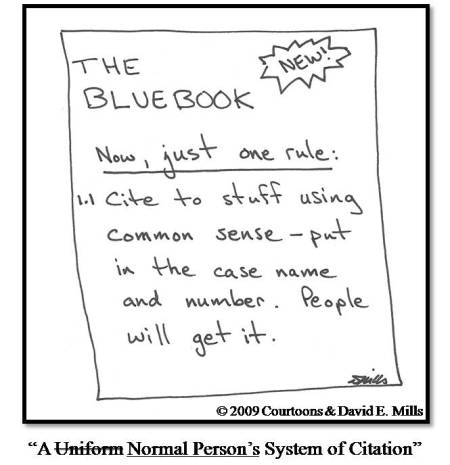 |
Bonus link: Offences against the library (via Daithí) updates Consequences.…
© cearta.ie 2024. Powered by WordPress