Archive for the “Universities” Category

ESRI logo, via the ESRI websiteI attended the Economic and Social Research Institute (ESRI) Higher Education Policy Conference yesterday on the topic “Higher Education Policy: Evidence from Ireland and Europe”. In the first session, Dr Selina McCoy of the ESRI spoke on “Higher education research in Ireland: where are we now?” and Muiris O’Connor of the Higher Education (HEA) spoke on “Higher education policy in Ireland: achievements and challenges”. In the second session, Professor David Raffe, Director of the Centre for Educational Sociology in the University of Edinburgh spoke on “Higher education policies across the UK since devolution” and Research Professor Liv Anne Støren of the Norwegian Institute for Studies in Innovation, Research and Education, Oslo spoke on “New trends in higher education in Norway – Are traditional male students ousted by female working class students and immigrant students?”. It was a fascinating series of presentations. Muiris O’Connor’s paper was an excellent survey of the evolution and present state of the Irish higher education sector. David Raffe’s paper put the higher education policy issues into context. Selina McCoy examined the very important specific issue of access to higher education in Ireland, whilst Live Anne Støren provided a comparative perspective on that issue. In this post, I’ll summarize what Muiris O’Connor had to say, and I’ll return to the other presentations tomorrow.

For Muiris O’Connor, the main achievement in Irish higher education policy is the participation rate. Over the last 50 years or so, after a late start – the free second level education scheme was introduced in 1967, about 25 years after the rest of Europe – there has been a rapid expansion of the third level sector and a rapid catch-up to international levels. Ireland is above the OECD average for 25-34 year-olds’ educational attainment in second and third level education. Although Ireland is not quite at OECD levels for PhDs, policy in recent years has been to boost that figure. On the other hand, Ireland is a long way from the OECD average for life-long learning rates. Moreover inequalities at the point of entry to higher education are still severe; in particular, there is a serious drop in participation by those just above the grant eligibility threshold. Read the rest of this entry »

Comments 5 Comments »

Dublin University logo, via WikipediaThe first item in the Trinity College Dublin (TCD) news feed at present is the report that Professor Petros Florides was recently inaugurated as a Pro-Chancellor of the University of Dublin. This reminds me that I often hear the question: “what is the University of Dublin for?”. And in the context of NUI Galway, NUI Maynooth, UCC, UCD et al, I often hear the similar question: “what is the NUI for?” Answers to these questions usually focus on history. The Charter of 1592 which founded TCD established it as “mother of a university”; whilst the Irish Universities Act, 1908 consolidated many of the existing Irish universities and colleges into the National University of Ireland. However, these answers only tell us where the University of Dublin and the NUI came from. They don’t tell us what these institutions are for. Other answers focus on degree-awarding powers, commencements, graduations, university governance, elections, connections with alumni, and ancillary academic services, before trailing off into a slightly embarrassed silence. These answers certainly get closer to telling us what these institutions are for, but they don’t really offer a strong justification for their continuing existence or future relevance. I’m actually a fan of both; and I think that the University of Dublin is symbiotically integral to Trinity College Dublin. Moreover, I do recognise the force of the objection implicit in the question “what are they for?”; and I think that one satisfactory answer might be to expand rather than to contract their roles. Read the rest of this entry »

Comments 1 Comment »

Graded Paper, viaFirst, to my posts on grading and marking, I must add a wonderful post by not that kind of doctor applying the Elisabeth Kübler-Ross model of five stages of grief – denial, anger, bargaining, depression, acceptance – to the process of grading papers! Wonderful (h/t efdel).

Second, in another grading and marking story, this time by way of comparison with my posts on Andrew Croskery’s case against QUB, consider the case of a student who sued the University of Pennsylvania for awarding him a degree from their engineering college rather than Wharton School of Business: his misrepresentation and unjust enrichment claims failed.

Third, in one of my posts on the Croskery litigation, I analysed a similar recent case in the Ontario Court of Appeal: Jaffer v York University 2010 ONCA 654 (7 October 2010). There’s an interesting post on the case on the Canadian blog, The Court, This Student Isn’t Just a Number:

(1) Universities: Now, Not-So-Independent Centres of Learning
Perhaps the most interesting and relevant aspect of this case concerns the Court’s finding that academic disputes grounded in contract or tort can be heard by the Superior Court of Justice in Ontario. Karakatsanis JA overturned the motion judge’s finding that academic disputes on the basis of a very recent decision not available to the motion judge, Gauthier v Saint-Germain 2010 ONCA 309.

Gauthier establishes that in cases where the elements of a breach of contract or negligence are properly pleaded, the Superior Court will have jurisdiction to hear a claim even when a dispute is academic in nature and arises from the academic activities of the university. While the University argued Gauthier was wrongly decided, Karakatsanis JA clearly addressed and disposed of this line of reasoning, finding that past decisions upholding the dismissal of claims relating to academic matters were done under r. 21.01(1) as the pleadings did not disclose a reasonable cause of action based upon tort, contract or negligence, not on the basis the court lacked jurisdiction.

Karakatsanis JA emphasized though, that the court’s jurisdiction will only extend to academic disputes with causes of action in tort or contract. For internal academic decisions not grounded in a civil cause of action, judicial review remains the appropriate remedy. However, the court will (and does) have jurisdiction to hear claims with a basis in tort or contract – the scholastic nature of the dispute is irrelevant.

In my opinion, I agree that this is the correct outcome. Establishing this guideline will only allow those claims with more substance than a single student’s biased belief or personal grudge to be heard. We must remember that students agree to be subject to their institution’s discretion in resolving academic matters upon enrolling, and only substantiated academic issues should be brought before the Superior Court.

Finally, for those who have reached this far, a cartoon from PhD Comics about the realities of weekend marking (click on the image for a bigger version):


Saturday grading, by PhD Comics, via their website

Comments 2 Comments »

Ivy covered West College, Princeton, via WikipediaSome time ago, I mused that Irish universities seeking the freedom to set their own fees might decide to “de-nationalise” and “go private” by means of a Unilateral Declaration of Independence, but I concluded then that it would never happen. Some time later, the old adage “never say never” proved itself once again, as I noted that the rector of Imperial College London suggested that Imperial, Oxford, Cambridge, the LSE and UCL should go private and form an independent US-style Ivy League. Earlier this year, Ferdinand von Prondzynski also speculated about this issue on his blog. Last week, things moved from speculation closer to reality: the Sunday Telegraph reported that Cambridge University is beginning to consider going private for precisely that reason, and the the Guardian yesterday reported that the LSE is doing likewise, amid fears a rise in tuition fees will not be enough to allow them to do what they already do let alone to compete with elite US universities. Of course, there are less drastic solutions, but the abolition of teaching grants for the humanities in the UK following the Browne Report might be the spur to this course of action:

Andrew Oswald, an economist and professor of behavioural science at Warwick Business School, says … “I certainly expect to see a number of large private universities of the kind that can rival the best on the east coast of America in my lifetime,” …. While he suggests Oxbridge could be reluctant to jump first, he expects it to happen among institutions near the top of the league tables. …

Nick Barr, professor of public economics at the London School of Economics, sees little danger in greater private provision, so long as it is tightly regulated, with institutions forced not only to meet robust quality assurance standards, but to be fully transparent and accountable, in return for their students receiving public loans – something on which much private sector provision depends.

In this context, as James Vernon points out in a provocative blogpost lamenting the impending end of the public university in England, Buckingham University, once the only for-profit private in the entire UK, may well become the model. Indeed, it may well become the model for Irish universities too. A report in this weekend’s Sunday Business Post suggested that the long awaited Hunt Report on a new national strategy for third-level education will be published soon, and it will recommend that universities should be directed for the first time to spend their funds on set education and research targets:

The proposals would see third-level institutions being forced to sign up to agreed targets in the areas of research, access to education, teaching standards, the retention of students and the rate of course completion, according to well placed sources.

Third-level colleges will retain their existing autonomy to allocate resources to achieve these targets. However, under the plans being considered, if the universities fail to achieve these targets, a ‘‘beefed-up’’ HEA will be authorised to intervene and insist that colleges redirect spending if necessary to meet agreed objectives.

This kind of suggestion might just be the spur for some Irish universities to investigate going private too. But even if they do, it won’t all be plain sailing. Another story in the same edition of the Sunday Business Post reports that almost €7 million have been invested in the loss-making educational company Independent Colleges. It is a recent entry into the growing market for private Irish third level colleges, and it is backed by media group Independent News & Media (INM):

It emerged in court that the company’s revenue is off target by €350,000 this year, and that it will have to make a further cash call on shareholders of up to €1.7 million.

Food for thought here, as universities in the UK and Ireland face into difficult decisions and an uncertain future. Perhaps someone should look into cultivating ivy on college buildings?

Comments 4 Comments »

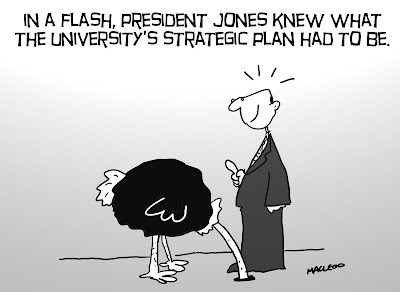
From the consistently wonderful MacLeod Cartoons, a cartoon called ‘University Strategic Planning‘:


University Strategic Planning, by MacLeod Cartoons, via their website


Comments No Comments »

QUB logo, via the QUB blogVia the incomparable 9th level Ireland blog, I (rather belatedly) learn that Andrew Croskery, a graduate of Queen’s University Belfast who has taken judicial review proceedings to challenge his degree results (on which I have previously blogged: 1, 2, 3, 4; and there is also an excellent post Jason Smith), might have got a result during the week. According to the BBC, QUB has agreed to review his grade. It seems that he was only 0.5% off obtaining a 2:1 in his degree, and in his judicial review proceedings, he claimed that if he had received better supervision he would have achieved that 2:1. On Tuesday, the High Court granted a three-week adjournment to allow QUB to review his degree classification on the alleged grounds of inadequate supervision and procedural irregularities. QUB told the Court that it made the proposal without prejudice in a bid to ease his concerns. Moreover, the Belfast Telegraph reported that if he is still unhappy with the outcome, he would now be able to appeal his results. As Education Law Blog points out

This appears to be a successful outcome for the student, as the provision of a review is about as much as he could have expected to achieve by way of his legal proceedings. Whether his degree result will actually be improved remains to be seen.

This change of tack on the part of QUB is surprising. According to the the Belfast Telegraph [with added links]:

Queen’s graduate’s courtroom challenge to awarding of 2:2 degree ‘opens a can of worms’

A landmark legal case being taken by a graduate seeking to overturn his degree classification could open up a “can of worms” for all academical institutions, it has been warned. … the University and College Union, which represents more than 120,000 academics and staff across the UK, has said this case could end up setting a “dangerous legal precedent” which could potentially threaten academic freedom.

Professor Bob Osborne, from the University of Ulster’s School of Criminology, Politics and Social Policy, said he was surprised that Queen’s had changed its stance.

I am very surprised that any university is prepared to re-open the classification of a degree after someone has graduated — unless due process has not taken place … If it is confirmed, it does open a huge can of worms. However it may be a defensive position that the university thinks it is better to get rid of the problem rather than having to go before the court. It is unusual unless a student has convinced the university that there has been some malpractice which has led to them being disadvantaged. Maybe they have now uncovered some new evidence.

Jonathan Bell, chairman of the Committee for Employment and Learning, said:

The consequences of any decision in this case are going to be major and I have no doubt that is in the minds of the people as they conduct themselves. There will be a lot of interest to see the outcome. What we at the Employment and Learning Committee will be asking is ‘what can we learn from this? The system has changed a lot culturally since I was at Queen’s in the late 80s when there were no fees and you got a grant. There has been a psychological shift where people are paying for a service therefore they want a good service. And, if there is something legitimate that they think is wrong with the service, they have a right to ask for a review. However I think that courts, in all situations, should be used as a last resort.

Comments No Comments »

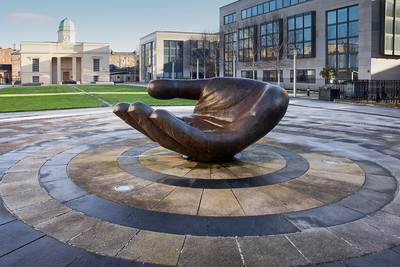
Sculpture outside Arthur Cox building, via Arthur Cox websiteI spent the morning at a seminar on Legal Issues for the Third Level Sector hosted by the Arthur Cox Technology & Intellectual Property Group. The morning was chaired by Rob Corbet.

First up were Claire McGrade and Karen Killoran discussing “The Arbitration Act 2010 and Other Forms of Alternative Dispute Resolution”. Claire discussed Alternative Dispute Resolution (ADR) in general, and Karen discussed the (also here). The second full paper was presented by Lisa Kinsella, on “Clinical Research at Third Level: Recent Developments in the Regulatory Framework”. And third was Tara MacMahon, who gave an update on the work implementing the recommendations of the Innovation Taskforce. Read the rest of this entry »

Comments No Comments »

York University law, via their website.Omar Ha-Redeye has blogged on Slaw about an Ontario CA decision that is very relevant to the judicial review proceedings being taken by Andrew Croskery to challenge his degree results in Queen’s University Belfast (on which I have previously blogged: 1, 2, 3). The gravamen of those posts was that courts are slow to disturb substantive academic decisions, though beyond that sphere, they will of course give effect to claims in tort or for breach of contract. This distinction is at the heart of the case at issue in Omar’s blogpost: Jaffer v York University 2010 ONCA 654 (7 October 2010).

In this case, the plaintiff challenged a decision to exclude him at the end of his first year because he had not maintained a sufficient grade average, on the grounds that the university had failed to make proper accommodation for his Trisomy 21 (Down’s Syndrome) and that he had detrimentally relied on an alleged promise by a professor to defer his status while the dispute over disability was resolved. His claim failed at first instance, in part on the ground that, “[w]hile there may be contractual or tortious issues within the broader claim, if the pith and substance of the impugned conduct is academic in nature, the action cannot be continued in the courts” ([24] Pitt J). This does not seem surprising, since the proposition that the Courts will be slow to interfere in matters of purely academic judgment is well-established as a matter of Canadian law (see, eg, Harelkin v University of Regina 1979 CanLII 18 (SCC), [1979] 2 SCR 561 (30 March 1979); followed in Ontario in Paine v University of Toronto (1982) 34 OR (2d) 770 (Ont CA) and Gauthier v Saint-Germain 2010 ONCA 309 (CanLII) (3 May 2010) ([30]-[31], [46], [50] Rouleau jca, en français)).

On the other hand, in Gauthier, Rouleau jca pointed out that since the relationship between a student and university is, of its nature, contractual, it can give rise to obligations both in contract and in tort ([32]-[33], [46]) and the court does not lack jurisdiction solely because the claim arises out of a dispute of an academic nature ([45]). This, too, is well established in Canadian law (Young v Bella 2006 SCC 3 (CanLII), [2006] 1 SCR 108 (27 January 2006)). As ever, the question is not so much about the line as to the side of it on which any given case might fall.

In the appeal in Jaffer, Karakatsanis JA held that Rouleau jca’s judgment in Gauthier “clarified that the decisions of this court upholding the dismissal of claims relating to academic matters did not do so on the basis that the court lacked jurisdiction …, but rather … because the pleadings did not disclose a reasonable cause of action based upon contract, tort, or negligence or … because the cause of action was untenable in law” ([22]). In other words, the proper judicial deference to academic decisions does not deprive the court of jurisdiction, but it does mean that the plaintiff has no exigible claim.

Hence, the question in Jaffer was not whether the dispute was academic in nature, but rather whether the pleadings support a cause of action in either contract or tort ([31]). Unlike Pitt J at first instance, Karakatsanis JA for the Court of Appeal held that appellant’s various claims did not implicate purely academic judgments, so she considered the breach of contract and negligent misrepresenation issues, and found them both wanting. In other words, the distinction between Pitt J and the Court of Appeal turned on the characterisation of the issues as purely academic or not. Unlike Pitt J, Karakatsanis JA held that the issues were not purely academic, and thus went on to consider whether there was a breach of contract or a tort. She found that there was no basis in the facts pleaded upon which to find that accommodation was an express or implied term of the contract between the university and Jaffer, and thus dismissed the breach of contract claim. She also found that the professor’s offer did not constitute a misrepresentation and that there was no causal link between the allged misrepresentation and the damages claimed, so she also dismissed the misrepresentation claim. However, she did allow the appeal to the extent of permitting Jaffer to amend the Statement of Claim to plead the breach of contract and negligent misrepresentation issues with greater particularity.

On this approach, the question which would arise in Andrew Croskery’s application is whether the matter is one of purely academic judgment. If it is, then the Court will not lack jurisdiction but it will be particularly slow to hold against the university. If it is not, then the court can go on to consider his substantive claims. I await Mr Justice Treacy’s decision with interest.

Comments 3 Comments »

Creative Commons Attribution-NonCommercial-ShareAlike 3.0 Unported
This work by Eoin O Dell is licensed under a Creative Commons Attribution-NonCommercial-ShareAlike 3.0 Unported.