Posts Tagged “constitutional theory”

Prof Adrienne Stone, CCCS, via their websiteProf Adrienne Stone (pictured left), Director of Centre for Comparative Constitutional Studies in the Melbourne Law School has just made a very interesting article available on SSRN. It is The Comparative Constitutional Law of Freedom of Expression, forthcming as a chapter is in Rosalind Dixon and Tom Ginsburg (eds) Research Handbook in Comparative Constitutional Law (Edward Elgar, forthcoming, 2011). Stone argues:

Freedom of expression is among the most widely protected of constitutional rights. Rights of freedom of expression can be found in constitutions drawn from all continents. … Even in those few democracies without comprehensive constitutional protection of rights, freedom of expression finds constitutional protection in other ways. It can plausibly be argued that parliamentary systems … – even in the era before the adoption of charters of rights – recognized a constitutional principle of freedom of expression that, though not enforceable by judicial review, was understood as a fundamental value that informed the reading of statutes and the common law. In addition, there are some legal systems that recognize a judicially enforceable principle of freedom of expression despite the absence of a written constitutional right.

… some scholars … question whether … the comparing free speech principles across constitutional systems is practical or useful for courts interpreting or applying constitutional principles of freedom of expression … The complexity of (and disagreement about) underlying philosophical commitments, the opacity of judicial decision making, and cultural specificity of any particular body of law, … [are] formidable problems for the comparativists, … and the] case for comparativism may be weaker in relation to constitutional principles have developed their own rich set of resources and a distinctive conception of freedom of expression. This latter description fits the First Amendment most neatly … [B]ut, outside of such contexts, the case for comparativism is much stronger. It is not surprising, then, that constitutional comparativism in freedom of expression cases as well as in other areas [is] certainly very widespread. … Successful comparativism within the field of freedom of expression, as elsewhere, requires a rather deep and critical engagement with foreign law that encompasses critical legal and philosophical literature on freedom of expression as well as case law. There is thus an increasing need for a research ‘infrastructure’ of informed, critical and widely comparative studies of freedom of expression that can support this comparative task.
I entirely agree with that last sentence. But that is the last sentence of the paper, suggesting that Stone is skeptical about the present existence of such an infrastructure. She does not need to be. In my view, there is a basic pattern of analysis when a right protected by a document of fundamental status (such as a Constitution or the European Convention of Human Rights) is potentially infringed or restricted by a statutory provision. It consists of four enquiries.

First, consider the restriction. Without a provision that infringes upon a constitutional right, there would be no need for this analysis.

Second, consider what rights the restriction might infringe. If speech rights are involved, then, in Ireland, that will be the right to express freely convictions and opinions Article 40.6.1.i of the Constitution, the (unenumerated) right to communicate in Article 40.3.1, or the right to freedom of expression, including the freedom to hold opinions and to receive and impart information and ideas, in Article 10(1) of the European Convention on Human Rights.

Third, since no right is an absolute, consider whether there are good reasons for the restrictions. The text of Article 40.6.1.i provides at least six: public order, morality, the authority of the State, blasphemy, sedition and indency; Article 40.3.1 protects rights only “in so far as practicable”; and the rights in both sections have been made subject by the judiciary to the exigencies of the common good. Article 10(2) has an extensive list of reasons for restrictions necessary “for the interests of national security, territorial integrity or public safety, for the prevention of disorder or crime, for the protection of health or morals, for the protection of the reputation or rights of others, for preventing the disclosure of information received in confidence, or for maintaining the authority and impartiality of the judiciary”. Any restriction must therefore pursue one of the iterated good reasons or “legitimate aims”, and that aim must be a serious one – there must be a “pressing social need” on the facts to trigger the trigger the relevant good reason legitimate aim. If there is no such good reason, legitimate aim, or pressing social need, then the restriction upon the relevant speech right will be unconstitutional or incompatible with the Convention.

Fourth, it is not enough that the State can simply point to one of the recognised good reasons justifying restrictions; it must also demonstrate that the restriction does not go too far. In other words, the restriction must survive a standard of scrutiny or review. In Ireland, the Supreme Court has established that a restriction upon a constitutional right must be proportionate to the reason underlying it, a standard which is informed by the approach of the European Convention on Human Rights.

As a matter of principle then, a four-part analytical structure can be identified: if there is a restriction upon the right to freedom of expression, the State must have a good reason to justify the restriction which can withstand scrutiny or review. These four Rs of constitutional review can easily provide the foundation or context of the research infrastructure of informed, critical and widely comparative studies of freedom of expression quite-rightly envisaged in Stone’s excellent article.

Comments 2 Comments »

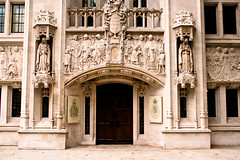
Image of UK Supreme Court building, via the UKSC blogNo, not the Irish Supreme Court, but the new UK Supreme Court. There’s quite a lot of coverage in the UK media and blawgopshere today about the new Court at the apex of UK’s judicial system, which opens for business today, on time and on budget, in a refurbished former criminal court, after a difficult gestation. David Pannick argues in the Times today that, however unhappy its origins, the opening of a new Supreme Court is an important commitment to the rule of law. Much of the media interest turns on the fact that the Court will be televised. For example, one of the pieces in the Times is headlined that TV coverage means justice really will be seen to be done:

The reform has taken a number of steps over 20 years: a Bar Council report chaired by Jonathan Caplan, QC, in 1989, the filming of parts of the Shipman inquiry and the Hutton inquiry and the 2004 pilot project in the Court of Appeal all moved the issue of cameras in court forward. … The footage will be filmed and recorded by the court and made available by a feed to broadcasters, … [and] can be used only for news, current affairs and educational and legal training programmes.

Read the rest of this entry »

Comments 1 Comment »

Áras an Uachtaráin = Residence of the President of Ireland, via the President's siteThe saga of the Defamation Bill, 2006 is not over yet. Article 26 of Bunreacht na hÉireann (the Irish Constitution) allows the President, after consultation with Council of State, to refer a Bill to the Supreme Court for a determination of its constitutionality. President McAleese has chosen to convene the Council of State to advise her on the qustion of whether to refer not only the (controversial) Criminal Justice (Amendment) Bill, 2009 (an unsurprising move) but also the (equally controversial) blasphemy elements of the Defamation Bill, 2006 (which has come as a great surprise). (See Belfast Telegraph | BreakingNews.ie | Bock the Robber | ICCL | Irish Emigrant | Irish Independent | RTÉ news | Irish Times | PA | Slugger O’Toole. Update (18 July 2009): see also Irish Examiner | Irish Times here and here | Irish Independent | MediaWatchWatch).

There have been 15 such references to date. If the Court holds that a Bill is unconstitutional, the President must decline to sign it; whilst if the Court decides a Bill is constitutional, the President must sign it into law, and the resulting Act is immune from constitutional challenge in the future. As my colleague Oran Doyle has pointed out, this means that

… unlike in ordinary constitutional litigation, a decision made under the Article 26 reference procedure without consideration of a particular issue cannot be reopened when that issue is brought to light by another aggrieved litigant. … The tenor of the court’s reasoning in several references suggests that the court is more likely to hold legislation unconstitutional when the effect of its decision is absolute immunity for legislation considered only in the abstract.

Admittedly, the reference procedure is imperfect (see, eg, Niamh Howlin “Shortcomings and anomalies: Aspects of Article 26″ (2005) Irish Student Law Review 26 (pdf)), but if it means that the odds are in favour of striking down the blapshemy provisions of the Defamation Bill, then bring it on!

The last sentence of Article 40.6.1(i) of the Constitution provides that the publication or utterance of blasphemous material shall be an offence. In Corway v Independent Newspapers [1999] 4 IR 484 (SC), the Supreme Court declined to give any effect to the constitutional clause in the absence of a statutory provision, but that decision will be of little help in any Article 26 reference. Rather more recently, in R (on the application of Green) v The City of Westminster Magistrates’ Court [2007] EWHC 2785 (Admin) (05 December 2007) (discussed on this blog at the time), a Divisional Court of the English High Court held that it was the prevention of imminent public disorder probably which ensured the compatibility of the English common law offence of blasphemous libel with Article 10 of the European Convention of Human Rights:

[17] … The Article 10(2) basis for the crime of blasphemous libel is best found, as it seems to us, in the risk of disorder amongst, and damage to, the community generally.

The key question will be whether the influence of the Convention will mean that the Court will take a similar approach to the Constitution. Let us assume that it will. Section 36 of the Bill provides that

(2) … a person publishes or utters blasphemous matter if—
(a) he or she publishes or utters matter that is grossly abusive 10 or insulting in relation to matters held sacred by any religion, thereby causing outrage among a substantial number of the adherents of that religion, and
(b) he or she intends, by the publication or utterance of the matter concerned, to cause such outrage.

(3) It shall be a defence to proceedings for an offence under this section for the defendant to prove that a reasonable person would find genuine literary, artistic, political, scientific, or academic value in the matter to which the offence relates.

Subsection (3) is a welcome saver, but the main question will be whether subsection (2) is constitutional. There is a large gulf between the outrage envisage by the subsection and the risk of public disorder envisaged by Green. If that case is right, then this provision must be questionable under the Convention; and if a similar approach is taken under the Constitution, then this provision must also be of dubious constitutionality. I will therefore await with great interest both the President’s decision and any subsequent decision of the Supreme Court. Of course, even if she decides not to refer either Bill, a constitutional challenge is likely the first time any of the controversial provisions are invoked. Either way, therefore, the blasphemy provisions of the Defamation Bill will get their day in court.

Comments 12 Comments »

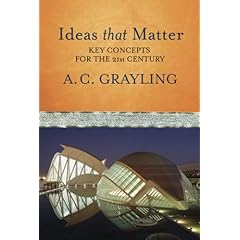
Index on Censorship has published a short edited extract from Ideas That Matter: Key Concepts for the 21st Century (Weidenfeld & Nicolson, 2009) by AC Grayling, Professor of philosophy at Birkbeck College, University of London, in which he provides a compelling and pithy case in favour of free speech and against censorship:

It’s a surprise to learn how universal censorship is

Cover of Grayling's While even the most tyrannical regime will pay lip service to free speech, it is a right that is constantly denied.

There are two bedrock civil liberties without which the very idea of civil liberty is empty. They are freedom of speech and due process of law. … The fundamental justifications for freedom of expression are as follows. First, it is an intrinsic right of every individual not to be forced to think, speak and believe at the dictate of others, but to do these things of their own free accord. Secondly, it is of the essence to the possession and protection of other liberties that individuals have this right. Thirdly, in the absence of the first two considerations, the full development of the human individual is vastly more difficult and in most cases not even possible, Fourthly, freedom of expression is essential to the interchange of ideas and views, and discussion of them, without which society cannot be healthy or mature. Fifthly, by means of the fourth point it promotes and aids the quest for truth or at very least sound and responsible knowledge. Sixthly, it is a vital check on government, which can too easily veer into tyranny without it. … the enemy of all that freedom of expression makes possible — the six points, at least, detailed above — is censorship. It comes as a surprise to most people to learn how universal censorship is, even in contemporary Western liberal democracies. … It is ubiquitous and constant. It does vastly more harm than good.

More here, here, here and here.

Comments 4 Comments »

Shakespeare, via Wikipedia
Image via Wikipedia

I have already glanced at the legal issues in The Merchant of Venice on this blog; but Shakespeare dealt with issues of justice and mercy in many other plays as well. Consider for example Measure for Measure (wikipedia | full text | Project Gutenberg), which juxtaposes imperfect justice on earth with merciful justice in heaven. Christine Corcos on the Law and Humanities Blog writes about a fascinating analysis of the play from a legal perspective (with added links):

Justice in “Measure For Measure”

John V. Orth, University of North Carolina, Chapel Hill, School of Law, has published “‘The Golden Metwand’: The Measure of Justice in Shakespeare’s Measure for Measure,” in the Adelaide Law Review. Here is the abstract.

Measure for Measure, one of Shakespeare’s problem plays, is a dark comedy depicting Duke Vincentio’s effort to restore respect for the law after a period of lax enforcement. Peopled with a wide variety of law-enforcers and law-breakers, the play implicates numerous legal issues and has consequently attracted the attention of lawyers and judges. In the eighteenth century Sir William Blackstone contributed notes on the play, while in the twentieth century judges have quoted from it in their judicial opinions. Like all good legal dramas, Measure for Measure ends with a trial scene, but – as we would expect from Shakespeare – one with an unusual twist. When charges of corruption are brought against Angelo, the deputy appointed to enforce the law, the Duke orders an immediate trial: Come, cousin Angelo / In this I’ll be impartial; be you judge / Of your own cause. When the deputy’s guilt is disclosed, the Duke commands that he suffer the punishment he intended for others – measure for measure, putting the Bible-conscious play-goer in mind of the passage: Judge not, that ye be not judged. / For with what judgement ye judge, ye shall be judged, and with what measure ye mete, it shall be measured to you againe. By ordering Angelo to be the judge of his own cause, the Duke is inviting the deputy to measure out his own punishment. And Shakespeare is forcing us all to confront the difficulty of doing earthly justice.

Download the article from SSRN here.

Bonus link: from the same blog, a post on a piece about Rumpole of the Bailey.

Comments 1 Comment »

Long Room Hub logoThe Irish Jurisprudence Society, with funding from TCD’s Long Room Hub Initiative, will host a public lecture by Professor Joseph Raz (Oxford and Columbia) at 7pm on Wednesday 25 February 2009 in the Lloyd Institute Building (pdf map here; dynamic map here). The evening will be chaired by Professor Desmond M Clarke, University College Cork; and Prof Raz will speak on the topic

Innovative Interpretation

The event is free, and all are welcome to attend, but numbers are limited so booking by email is essential.

Comments No Comments »

Emblem of Thailand, via widipedia.Two Australian stories recently caught my eye; and, although at first blush the only link is Australia, there is in fact a deeper connection. The first is from the BBC news Website:

Writer jailed for Thai ‘insult’

Australian writer Harry Nicolaides has been sentenced to three years in a Thai jail for insulting the monarchy. Nicolaides wrote a novel four years ago, which contained a brief passage referring to an unnamed crown prince. It sold just seven copies.

He admitted the charge of insulting the royal family, but said he was unaware he was committing an offence. Thailand’s monarchy is sheltered from public debate by some of the world’s most stringent “lèse-majesté” laws.

Read the rest of this entry »

Comments 3 Comments »

Cover of New Yorker magazine, Dec 22 & 29, 2008.I learn from this week’s New Yorker (cover, left) that the Cardozo School of Law of New York’s Yeshiva University that Shylock was finally able to appeal the judgment rendered against him in Shakespeare’s The Merchant of Venice (advance notice | poster (pdf) | YU news story | photos).

A Jewish moneylender in Renaissance Venice, Shylock had made a loan to Antonio, in default of which he would entitled to a pound of Antonio’s flesh. Antonio defaulted, and Shylock sought specific performance. But, after Portia’s advocacy on behalf of Antonio, the Duke of Venice ruled that Shylock was entitled to a pound of flesh but not a drop of blood, and refused both specific performance and damages in lieu. More than that, for seeking to take Antonio’s life, Shylock was disgraced and forced to convert to Christianity, and his property was forfeit (though half was ultimately settled upon his daughter Jessica, who had converted to Christianity and eloped with her suitor, Lorenzo). Read the rest of this entry »

Comments 3 Comments »

Creative Commons Attribution-NonCommercial-ShareAlike 3.0 Unported
This work by Eoin O Dell is licensed under a Creative Commons Attribution-NonCommercial-ShareAlike 3.0 Unported.