Posts Tagged “Holocaust”

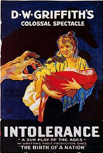
Poster for DW Griffith movie IntoleranceIn DW Griffith’s silent-era powerful – if flawed – classic movie, Intolerance (1916) (IMDB | wikipedia), the contemporary story of a poor young woman, separated by the intolerant prejudice of social reformers from her husband and baby, is interwoven with tales of intolerance from ancient Babylon, New Testament Judea, and Reformation France. These fables vividly warn of the dangers of intolerance. Two stories in today’s media demonstrate that intolerance of intolerance is simply intolerance, and is all the more dangerous for that.

UCC society withdraws Nick Griffin invite to ‘free speech’ debate

… In a statement this afternoon, the UCC Government and Politics Society said it had withdrawn the invitation as a result of submissions from University staff and Gardaí, who had outlined a “potential threat to the safety and welfare of our students and the general public”.

As with the earlier TCD debacle, this is as inevitable as it is dismaying.

French Senate passes bill outlawing genocide denial

… France’s upper house of parliament approved a bill on Monday that would make it a criminal offence to deny genocide, legislation that has caused tension between Paris and Ankara. The bill, which was approved by the lower house in December, has triggered outrage in Turkey as it would include the 1915 mass killing of Armenians in Ottoman Turkey.

As with earlier attempts to legislate truth, this is profoundly misguided.

We must not meet intolerance with intolerance. We must persuade others to avoid the intolerant; but we must not ban the intolerant; because, if we do, we become as bad as they are.

Bonus links, from the Irish Times (24 January 2012): UCC invitation to BNP leader pulled; Turkish fury likely over French bill on Armenian genocide; and Shatter opens Holocaust exhibition.

Comments 1 Comment »

Updates logo, via Apple websiteI suppose if I spent ages thinking about it, I could find a spurious thread linking three stories that caught my eye over the last few days, but in truth there is none, except that they update matters which I have already discussed on this blog. (Oh, all right then, they’re all about different aspects of freedom of expression: the first shows that copyright should not prevent academic discussion; the second shows that hecklers should not have a veto; and the third is about broadcasting regulation).

First, I had noted the proclivity of the estate of James Joyce to be vigorous in defence of its copyrights; but it lost a recent case and now has agreed to pay quite substantial costs as a consequence:

Joyce estate settles copyright dispute with US academic

The James Joyce Estate has agreed to pay $240,000 (€164,000) in legal costs incurred by an American academic following a long-running copyright dispute between the two sides. The settlement brings to an end a legal saga that pre-dates the publication in 2003 of a controversial biography of Joyce’s daughter, Lucia, written by Stanford University academic Carol Shloss. …

More: ABA Journal | Chronicle | Law.com | San Francisco Chronicle | Slashdot | Stanford CIS (who represented Shloss) esp here | Stanford University News (a long and informative article).

Second, I have long been of the view that hecklers should not be allowed to veto unpopular views, and none come more unpopular that holocaust-denier David Irving. Now comes news that NUI Galway’s Lit & Deb society have withdrawn their controversial invitation to Irving for security reasons:

David Irving address in NUIG cancelled due to ‘security concerns’

The proposed visit of the controversial historian David Irving to the NUI, Galway Literary & Debating Society has been cancelled. In a statement the Lit & Deb said the cancellation was “due to security concerns and restrictions imposed by the university authorities”. …

Read the rest of this entry »

Comments 1 Comment »

Yad Vashem, The Holocaust Memorial, Jerusalem.Since writing my previous post, I have read (hat tip: Ninth Level Ireland) a trenchant statement of the opposite view by Prof William Schabas, Director of the Irish Centre for Human Rights at NUI Galway. His argument is twofold. First, he refers to the EU Framework Decision on racism and xenophobia (pdf). Second, he argues that, whatever about that Decision, Ivring should not as a matter of principle be granted a prestigious platform by the Lit & Deb. He illustrates this second point with a rhetorical flourish:

There are also cranks who believe that the earth is flat, but we don’t invite them to deliver seminars in the geography department.

And he concludes that

… any reasonable reading of the EU Framework Decision should lead to the conclusion that he cannot be welcome in Ireland, or at the University.

Read the rest of this entry »

Comments 20 Comments »

Anthony Lewis Freedom of expression matters most where the expression in question is unpopular: if it it is to mean anything, it must mean “freedom for the thought that we hate” (US v Schwimmer 279 US 644, 655 (1929) Holmes J); it covers not only mainstream ideas which hardly need protection, but also those that “offend, shock or disturb the State or any sector of the population” (Handyside v United Kingdom 5493/72 [1976] ECHR 5 (7 December 1976) [49]). That is why this blog has defended the right to freedom of expression especially when it involves unpopular opinions or unpopular speakers.

There are no more unpopular ideas than the denial of the Holocaust, and there are no more unpopular speakers than David Irving. Even here, in my view, we should give speech a chance: the best way to ensure that we never forget the Holocaust is to debate it at every turn, not to suppress speech from Irving’s ilk. The Oxford Union got good headlines last year when it invited Irving to debate about freedom of expression. Now it seems that NUI, Galway’s Literary and Debating Society are about to repeat the trick. Read the rest of this entry »

Comments 8 Comments »

Holocaust Memorial Day image, via UN General Assembly site.The national Holocaust Memorial Day commemoration takes place on the Sunday nearest to 27 January every year (that is the anniversary of the liberation of the concentration camp at Auschwitz-Berkenau, and has been designated as Holocaust Memorial Day by the UN General Assembly). This year, it is Sunday 25 January next.

Witnesses of War, cover, via Random House website.As part of that commemoration, my Trinity colleagues in the Department of History and the Herzog Centre for the Study of Jewish and Near Eastern Religion, along with the Holocaust Educational Trust of Ireland (HETI), will host this year’s annual Holocaust Memorial Lecture this evening.

Dr Nicholas Stargardt, Magdalen College Oxford, author of (among many other publications) Witnesses of War. Children’s Lives Under the Nazis (Random House, 2007; amazon) will speak about

Jewish Children in Hiding

It is in the Thomas Davis Lecture Theatre (Room 2043), in the Arts Block, Trinity College Dublin, at 7:30pm (college maps and directions here). All are welcome to attend. Further information is available here and here.

Update (26 January 2009): Holocaust survivors remember victims with moving Mansion House ceremony

Comments 1 Comment »

UCD Law Soc logo, via their siteThere is a certain irony that, on Holocaust Memorial Day (on which I have blogged here), today’s Sunday Business Post reports that Jean-Marie le Pen, leader of the far right wing French party Le Front National, has delayed his trip to Ireland due to media coverage of the invitation extended by the UCD Law Society to him to speak against the Lisbon Treaty. As a contentious politician who seems to thrive on the publicity generated by controversy, I am sure he expected some objections, but it seemed to me that neither the reaction nor the coverage was particularly virulent. Read the rest of this entry »

Comments 3 Comments »

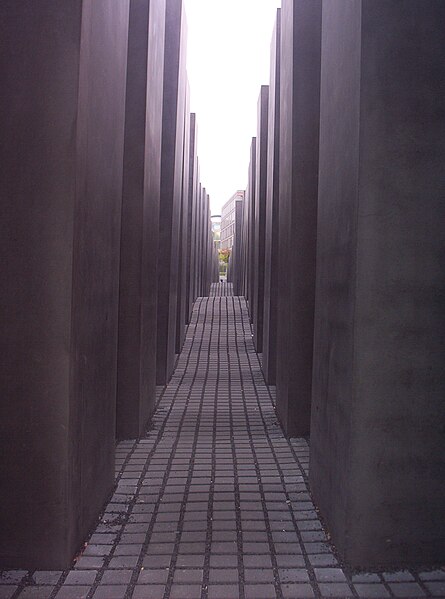
Holocaust Memorial, Berlin via widipedia.The 2008 Holocaust Memorial Lecture will be delivered by Professor Christopher Browning, tonight (Monday, 21 January 2008) at 7:30pm, in the Edmund Burke Theatre, Arts Building, Trinity College Dublin (map).

The subject will be the memory of Holocaust survivors:

Remembering Survival: Postwar Testimonies from the Starachowice Slave Labour Camps

Christopher R. Browning is Frank Porter Graham Professor of History at the University of North Carolina – Chapel Hill, and internationally recognized as one of the top historians of Nazi Germany and the Holocaust. His book on how ordinary men took part in mass killing in Nazi-occupied Poland is widely recognized as one of the most insightful studies of the perpetrators of genocide (Ordinary Men: Reserve Police Battalion 101 and the Final Solution in Poland, Harper Collins, 1992 (Amazon)). More recently he has turned from the politics of the genocide to the perspective of survivor victims and the issue of memory. It is this that he will address in the Holocaust Memorial Lecture, which is an annual public event sponsored by the Department of History and the Herzog Centre for Jewish and Near Eastern Religion in Trinity College Dublin, and by the Holocaust Educational Trust of Ireland.

Some additional comments:

  • The 2007 event is blogged here.
  • Holocaust Memorial Day will be commemorated next Sunday, 27 January 2008 (in 2006, the United Nations General Assembly designated January 27 as an annual international day of commemoration to honor the victims of the Nazi era).
  • Spanish Holocaust Denial legislation was struck down on free speech grounds before Christmas (bitacoras juridicas (in Spanish)).
  • Ernest Zundel’s lawyer has been sentenced to prison in Germany for Holocaust Denial last week (FindLaw via Media Law Prof).
  • Comments 1 Comment »

    I am a politics junkie – I will watch party conferences and conventions, and enjoy the experiences! And I still remember a Fianna Fáil Árd Fhéis (national party conference) in which Charlie Haughey began a key section of his leader’s speech by asserting: “The truth, as we in Fianna Fáil see it, is …”. I don’t remember what he said after that, because I was so flabbergasted at the audacity of making truth contingent upon a political point of view. Of course, this was only a small thing compared to the flabbergasting audacity of other aspects of Haughey’s career, but the attitude of subordinating truth to political power is not unique to him or to Fianna Fáil. A particularly egregious example is provided by reports this morning that the author of a book on anti-Semitism in Poland may face court action. According to Derek Scally in the Irish Times (sub req’d):

    The public prosecutor in Krakow has launched a preliminary investigation into a US historian who says post-war Poland continued where the Nazis left off in persecuting Jews. Jan Tomasz Gross [home page at Princeton | wikipedia] could, under a law passed by the Kaczynski government, face a prison sentence if found guilty of “accusing the Polish nation of participating in communist or Nazi crimes”.

    The new Polish edition of Dr Gross’s 2006 book, Fear – Anti-Semitism in Poland after Auschwitz, has caused a storm for challenging the country’s self-image as the heroic, leading martyr of the second World War. The book documents post-war pogroms that claimed the lives of up to 3,000 of Poland’s 300,000 Holocaust survivors. The most notorious pogrom happened on July 4th, 1946, in Kielce, when a mob rounded up and killed 42 returned Holocaust survivors after a false rumour spread that Jews had kidnapped and killed a local boy. …

    I have previously blogged (here and here) about earlier attempts by the the Kaczynski government to legislate truth, and this most recent example is as abhorrent and misguided as they were. Either the Polish record after WWII is pure as the snow in Katyn Forest in winter, or it isn’t. Read the rest of this entry »

    Comments 1 Comment »

    Creative Commons Attribution-NonCommercial-ShareAlike 3.0 Unported
    This work by Eoin O Dell is licensed under a Creative Commons Attribution-NonCommercial-ShareAlike 3.0 Unported.