Posts Tagged “Google”

Google image, via GoogleA little later than promised, here are some thoughts that occurred to me at the recent seminar on Promoting innovation – Reshaping the Law for the Digital Economy (which I blogged here and here). In the same way that browsers have a constant battle between features and speed, so the modern law of copyright is faced with a similar dilemma between encouraging and rewarding innovation. It is becoming increasingly clear that it has not solved this dilemma in a particularly satisfactory way. More than that, the most popular emerging solution – the introduction of a fair use defence to EU law – may not be sufficient for current needs, let alone for future developments.

At the seminar, Johnny Ryan argued that with the rise of the internet, where everything is in perpetual beta, we are in effect are reverting back to the pre-Gutenberg plasticity of information. In historical terms, this is the norm. It is the post-Gutenberg era of fixed information which is the anomaly. Copyright is a feature of this period: in the 1500s, it developed to protect the publishers; in the second half of the 1600s it came under increasing pressure to protect authors, and this was codified in the Statute of Anne, 1710; thereafter, the statutory protections were slowly expanded to other creators of other original works. The fundamental (even if increasingly questioned) justification for this development is that the copyright monopoly encourages the creation of original works.

This development of copyright has been a very slow process, but two current issues are putting significant pressure on this slow pace. The first is the evolution beyond the static to the plastic described by Johnny Ryan; the second is that the rate of this change is exponentially faster than heretofore. Copyright rules rules created for static texts which at best change slowly are rules that are ill-adapted to faster change and inappropriate to the modern reality of plastic texts. Read the rest of this entry »

Comments 3 Comments »

Google image, via GoogleAs I said my first post yesterday, last Friday morning I attended a seminar on Promoting innovation – Reshaping the Law for the Digital Economy, hosted by Google Ireland, co-sponsored by the Institute for International and European Affairs (IIEA), and chaired by TJ McIntyre. In that post, I summarized the presentations by Johnny Ryan (the internet has created a hinge in history when information is plastic and copyright law is a block upon total commerce) and Niall O’Riordan (for Google, a fair use doctrine in Ireland and Europe is an idea whose time has come). In this post, I’ll look at last Friday’s other presentations; and in tomorrow’s post, I’ll add a few comments of my own on some of the issues raised by the seminar.

Kate O’Sullivan (Director of Regulation and Public Policy, UPC Ireland) pointed out that intermediaries (such as Google, Facebook, and ISPs) are caught in the middle between content producers seeking to enforce their rights as against users, and it is not appropriate that ISPs should be judge and jury in such a cause. Section 40(3) of the Copyright and Related Rights Act, 2000 (also here) provides that the mere provision of facilities by an ISP, for example, which enable the making available to the public of copies of a work “shall not of itself constitute an act of making available to the public of copies of the work” and therefore shall not for that reason amount to a copyright infringement.

She examined the main rights of each of the three main involved: rights holders, subscribers, and intermediaries. Read the rest of this entry »

Comments 2 Comments »

Google image, via GoogleLast Friday morning, I attended a seminar on Promoting innovation – Reshaping the Law for the Digital Economy (Irish Times | SiliconRepublic here and here). It was hosted by Google Ireland and co-sponsored the by Institute for International and European Affairs (IIEA); and the morning was very ably chaired by TJ McIntyre (blog | Chair, Digital Rights Ireland | Consultant, Merrion Legal | UCD). There were five presentations; in this post, I’ll deal with the first two; in the next tomorrow’s post, I’ll deal with the remaining three; and in a third post, I’ll add a few comments of my own on some of the issues raised by the seminar.

First up was Johnny Ryan (IIEA | author A History of the Internet and the Digital Future) speaking on “A hinge in history: the conditions of the digital future and the need of rights reform”, and setting the scene for the debates that would follow. (Update: Johnny comments below that video of his presentation is now available). For him, we live in the age of the perpetual beta. Before Gutenberg’s printing press, hand-transcribed manuscripts made information fluid. By contrast, after Gutenberg, the printed book fixed information in static form. But now, online, information is very flexible and plastic, again. Consider a wikipedia page: everything is open to challenge and experimentation – and perpetually beta. We are reverting back to the pre-Gutenberg plasticity of information. In historical terms, this is the norm. It is the post-Gutenberg era of fixed information which is the anomaly. Because of the internet, we have moved from a read-only (RO) culture to a read-write (RW) culture, a remix culture, where we can all adapt and re-invent, and this participation can be anywhere: anyone can be Andy Warhol, and the internet can be your Factory. This is the hinge in history of his title.

He argued that as we have moved from a RO to a RW culture, so can we move from RO to RW business. Read the rest of this entry »

Comments 4 Comments »

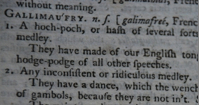
GallimaufryDr Johnson defined gallimaufry as

1. A hoch-poch …
2. Any inconsistent or ridiculous medley. …

Here’s another hoch-poch, or hotch-potch (though, of course, not a hotchpot) of links relevant to the themes of this blog that have caught my eye over the last while. I’ll begin and end with some stories of censorship, and along the way I’ll mention open wifi, international perceptions of Ireland, typography, mobile phones, broadcasting, and the future of our universities.

First, as a supplement to my post on the Lady Chatterley’s Lover trials, Alan Travis in the Guardian argues that the failure of the Chatterley prosecution secured the liberty of literature in Britain over the past 50 years. By way of a similar supplement to my post on the decision of the European Court of Human Rights in Akdas v Turkey 41056/04 (15 February 2010) that a Turkish ban on Apollinaire’s Les Onze Mille Verges infringed Article 10 of the European Convention on Human Rights, the Guardian reports that Turkey is at it again: publisher Irfan Sanci is being prosecuted – under the same Turkish provisions that were found wanting in Akdas – for publishing a translation of another Apollinaire noverl, Les exploits d’un jeune Don Juan (The Exploits of a Young Don Juan). To add insult to this injury, the prosecution comes in the week before Sanci is to be bestowed with a special award by the Geneva-based International Publishers Association. Read the rest of this entry »

Comments 2 Comments »

At Ignite Dublin #4, held in TCD’s Science Gallery as part of last week’s Trinity Week celebrations, I gave a 20-slides-in-5-minutes presentation on Ten Copyright Myths, in part because the previous weekend saw the 300th anniversary of the first modern copyright statute, the Statute of Anne, 1710 (fascimile | transcript | wikipedia). For the day that’s in it, here’s a YouTube video of my presentation:


For those who don’t have 5 minutes to watch, here are the myths debunked:

  1. You don’t need to put the copyright symbol © on a text to claim copyright. All that matters is that the work is original.
  2. You don’t need to put it in an envelope and send it to yourself. If the work is original, then copyright just vests.
  3. There is no doctrine of fair use outside of the United States. Instead, there is a much more limited doctrine of fair dealing for the purposes of research or criticism.
  4. Just because something has been published on the internet doesn’t mean that it’s in the public domain. There’s a lot less in the public domain than you might think.
  5. Taking a work, and transforming it, still infringes copyright.
  6. Giving credit is important; but if the taking is a copyright infringement, giving credit doesn’t change that fact.
  7. Taking a copyright work, but not charging for your use, will still be an infringement if the taking is a copyright infringement.
  8. The fact that the original author is dead doesn’t mean the work is out of copyright. The copyright term is the life of the author plus seventy years.
  9. Creative Commons is a good development, but it’s just a system of licences or permissions, and it won’t change the copyright world.
  10. Finally, just because Google are copying books doesn’t mean the rest of us can: they have permission pursuant to a court settlement.

So, there you have it, ten copyright myths debunked. What others would you add to the list?

Comments 6 Comments »

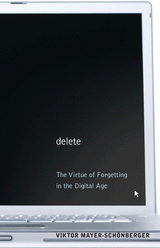
Cover of I remember this one time, at BarCamp Dublin, I went to Darren Barefoot’s presentation, and he said

Things live forever on the web … the internet never forgets.

Total recall online is now a common trope, and one which forms the starting point of Viktor Mayer-Schönberger’s provocative new book Delete: The Virtue of Forgetting in the Digital Age (Princeton University Press, 2009). Your privacy is gone, and you don’t know what you’ve lost till it’s too late. Two years ago, Dan Solove warned in The Future of Reputation: Gossip, Rumor, and Privacy on the Internet (Yale University Press, 2007) that a permanent online chronicle of our private lives could mean that the freedom of the internet makes us less free. Now, for the “future that is forever unforgiving because it is unforgetting”, Mayer-Schönberger proposes the remedy of induced forgetting for the internet’s elephantine memory Read the rest of this entry »

Comments No Comments »

Protest poster, via Index on CensorshipIn the 21st century, the power to censor is not just a matter of state action, and 21st century censorship requires 21st century responses. From the Index on Censorship Free Speech Blog, John Kampfner, CEO of Index on Censorship, writes about their day of action against 21st Century censorship (some links in original, some added):

The new free expression debates

On the morning of Monday 12 October, Index on Censorship will be teaming up with Policy Exchange and Google to discuss free expression and the Internet. Later that day, Liberty and Index on Censorship will stage Protest! an exciting event encouraging students to exercise their right to free speech, with special guest Sir Hugh Orde, head of the Association of Chief Police Officers.

Why, people might sensibly ask, is Index on Censorship engaging with one of the world’s leading technology corporations and one of Britain’s top police chiefs? The answer is because we no longer see free expression only through the traditional prism of outright state censorship of or violence against writers and journalists.

The issue is more complex than that now. …

More here.

Comments No Comments »

Amazon logo, via their siteIf you liked my posts about the gatekeeper responsibilities of search engines, then you’ll have loved last week’s furore over Amazon’s decision to disable search and sales ranking for “adult” material. I followed the controversy via John Naughton’s Memex 1.1 blog, here, here and here (pointing to his column in last weekend’s Observer). It has long been a source of worry that private actors such as Google and Amazon should retain so much personal data as to raise significant privacy concerns. More recently, the range of worry has broadened, with the realisation that such companies can not only manipulate their databases to target advertising at their users, but they can also manipulate them to prevent the users having access to data. Lawyers notoriously understand very little about internet reserach, and so have great difficulty in addressing the kinds of legal and regulatory issues that such manipulation reveal. I have recently blogged about articles by Oren Bracha and Frank Pasquale and by Emily B Laidlaw, arguing that actors such as Amazon and Google should come under common law duties analagous to those that govern public utilities.

More generally, over on Concurring Opinions, a rolling symposium, starting here, is considering Danielle Citron’s seminal article “Cyber Civil Rights” 89 Boston University Law Review 61 (2009). In its details, it’s a million miles from Bracha, Pasquale, and Laidlaw; but in its strategy, it reinforces their way forward. Read the rest of this entry »

Comments No Comments »

Creative Commons Attribution-NonCommercial-ShareAlike 3.0 Unported
This work by Eoin O Dell is licensed under a Creative Commons Attribution-NonCommercial-ShareAlike 3.0 Unported.